
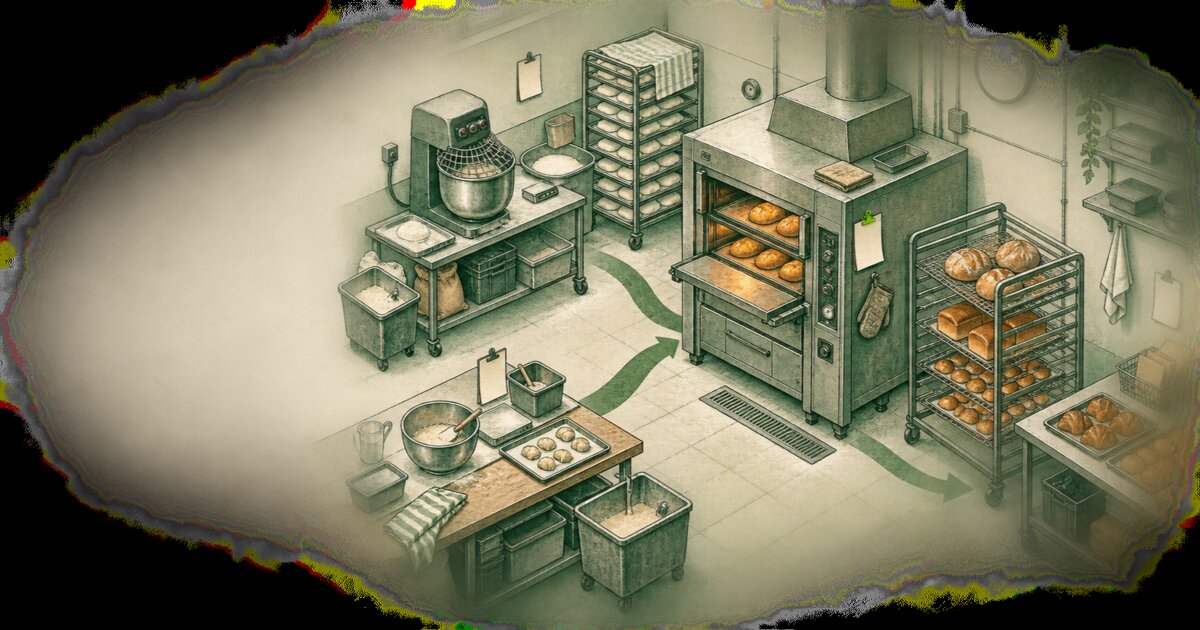
At 5:30 in a Chennai bakery, six products can all look urgent. The pre-ordered cake needs decorating. Pav must reach the counter before breakfast. Puffs need the same oven window.
Yesterday’s unsold tray is still visible, but so is the memory of selling out too early last Sunday.
The answer is not “bake a little extra”. A useful plan makes two decisions: how many whole batches to make, and when each batch can move through the constrained part of the bakery.
Calculate quantity before touching the clock
Keep firm demand and uncertain demand in separate columns. A paid or confirmed order is not the same as a counter estimate. Opening stock counts only when it will still be safe, saleable and acceptable at the planned selling time.
Use this first line for each product:
Net units to produce = firm orders + counter forecast - usable opening stock
The counter forecast should come from comparable days, then be adjusted for known events. An ordinary Tuesday is a better starting point for next Tuesday than a festival Sunday. Write the adjustment beside the number: rain, school holiday, office order, promotion or local event. That note is what lets the owner judge the forecast later.
| Input | What belongs in the cell | What does not |
|---|---|---|
| Firm orders | Confirmed quantity and promised time | Enquiries or an optimistic sales target |
| Counter forecast | Expected walk-in and same-day channel demand | Last week’s total copied without a day check |
| Usable opening stock | Product that can genuinely be sold in the planned window | Anything already past the bakery’s quality or safety rule |
| Net units | The quantity the bake plan must cover | A rounded batch count |
This is a production quantity, not yet a schedule. It also is not a revenue forecast. Selling price, batch cost and food cost belong in the commercial review; Mikro’s guide to food-cost percentage shows how opening stock, purchases and closing stock connect over a reporting cycle.
Round to batches and show the surplus
A bakery cannot usually make 5.54 standard batches. Round up to a whole batch, but keep the consequence visible.
Whole batches = ceiling(net units to produce ÷ standard sellable yield)
Rounding surplus = whole batches × standard yield - net units to produce
Here is an illustrative pav-pack calculation. These are teaching numbers, not a Chennai demand or yield benchmark.
| Worked input | Illustrative value |
|---|---|
| Firm orders | 62 packs |
| Counter forecast | 76 packs |
| Usable opening stock | 5 packs |
| Net units to produce | 133 packs |
| Standard sellable yield | 24 packs per batch |
| Whole batches | 6 |
| Planned output | 144 packs |
| Rounding surplus | 11 packs |
Those 11 packs are not automatically waste. They are the visible price of the batch boundary. The bakery can accept that exposure, move part of the forecast to a later bake, or change the standard batch only if the recipe and equipment allow it. Hiding the surplus inside a flat “five per cent buffer” makes the decision harder to see.
Build the schedule backward from ready-by time
Now put time around the quantity. Start with the promised counter or pickup time and work backward through cooling, baking, proofing or resting, shaping, mixing and setup. The route differs by product; that is why a list of batch counts alone cannot run the morning.
Original bakery-scheduling research models this as a sequence of dependent stages with machine capacity, employee availability and oven preparation in the same problem. It also shows that the shortest total production run and the least oven idle time are not necessarily the same objective (Babor et al., Scientific Reports, 2023). The paper’s optimisation results are not a benchmark for an Indian retail bakery. The useful point is simpler: the route and constraint must be written down before anyone can improve them.
For each product, keep a small master row:
| Field | Why the scheduler needs it |
|---|---|
| Standard sellable yield | Converts required units into whole batches |
| Governing capacity | States whether mixer, prover, oven, cooling rack or bench limits the batch |
| Stage order and standard time | Lets the plan work backward without impossible overlaps |
| Compatible oven load | Prevents two products sharing a load when their settings or timings conflict |
| Ready-by time | Protects confirmed orders and counter opening |
| Named owner | Makes the hand-off visible when one person covers several stages |
If the example bakery’s oven can carry two compatible pav batches per load, six batches need three oven loads. That arithmetic is useful only after the team confirms tray capacity, recipe compatibility and the validated bake settings. “There is space” is not the same as “these can bake together”.
The batch count decides how much. The route decides whether it will be ready.
Keep safety limits outside the optimisation
A faster schedule is wrong if it stretches a controlled recipe step or leaves a short-life filling on the bench. FSSAI’s Bakery Level 2 training manual says ready-to-eat materials such as cream, icing, mousse and butter should be prepared only as required in small batches, with demand estimated to avoid overproduction and prolonged storage. It also treats fermentation as time-bound and the baking time-temperature relationship as important (FSSAI FoSTaC bakery training manual).
The production sheet should therefore carry the bakery’s approved process and food-safety limits as fixed conditions. Scheduling can move a start time or split a permitted batch. It cannot invent a shorter proof, change a bake setting, extend a filling’s bench time or skip cooling because the counter is waiting.
Close the loop with actuals, including stockouts
At closing, planned output is only half the record. For each product, capture what was completed, sold, still usable, wasted and unavailable because of a stockout. Keep waste reasons separate: process loss, quality rejection, damage, sample, return and end-of-life stock do not point to the same fix.
Sales can understate demand. If a product sold out at 6:00 pm, the till shows only what was available before 6:00. It cannot show how many later customers would have bought it. Mark the stockout time and treat that day’s counter demand as a lower bound, not a clean forecast result.
Review comparable days, not one dramatic shift. If three ordinary Fridays finish with the same product left, lower its counter forecast or move part of it to a later batch. If the product repeatedly sells out while the oven is occupied by slower stock, the correction may be sequence or capacity rather than a larger opening batch.
When standard batch cost is updated, use the bakery’s current invoices. Chennai operators can also compare relevant pantry rates on Mikro’s daily price list, but a public rate never replaces the landed cost, pack, grade and supplier terms on the bakery’s own purchase record.
Once opening stock, purchases, closing stock and sales are closed for the reporting cycle, the food-cost calculator can test whether the production changes are improving the wider cost percentage. Do not claim a saving from lower waste if shortages, overtime or lost sales moved the cost somewhere else.
A one-sheet daily routine
Run tomorrow's bake on one page
Record standard sellable yield, route, stage times, capacity, approved process limits and shelf-life rule. Change the master only when the recipe or process actually changes.
Put confirmed orders and counter forecast beside each other. Subtract only opening stock that will remain usable at the selling time.
Convert net units to whole batches. Show planned output and rounding surplus so the owner can choose an earlier or later bake deliberately.
Work backward from ready-by times. Assign oven loads, cooling space and a named owner without overlapping work that one person or machine cannot do.
Record actual completion, sales, usable balance, stockout time and waste by cause. Carry the learning only to the next comparable day.
The sheet can live on paper or in a spreadsheet. Software becomes useful when the bakery has stable definitions to automate. A colourful dashboard built on an unclear batch yield only makes the wrong number arrive faster.
Frequently asked questions
Frequently asked questions
5 QHow do I plan daily production in a bakery?
How many batches should a bakery make each day?
Should a bakery add a wastage buffer to its forecast?
How should a bakery plan oven time?
How does a bakery improve tomorrow's forecast?
For more practical food-business operating guides, browse the Mikro blog.