
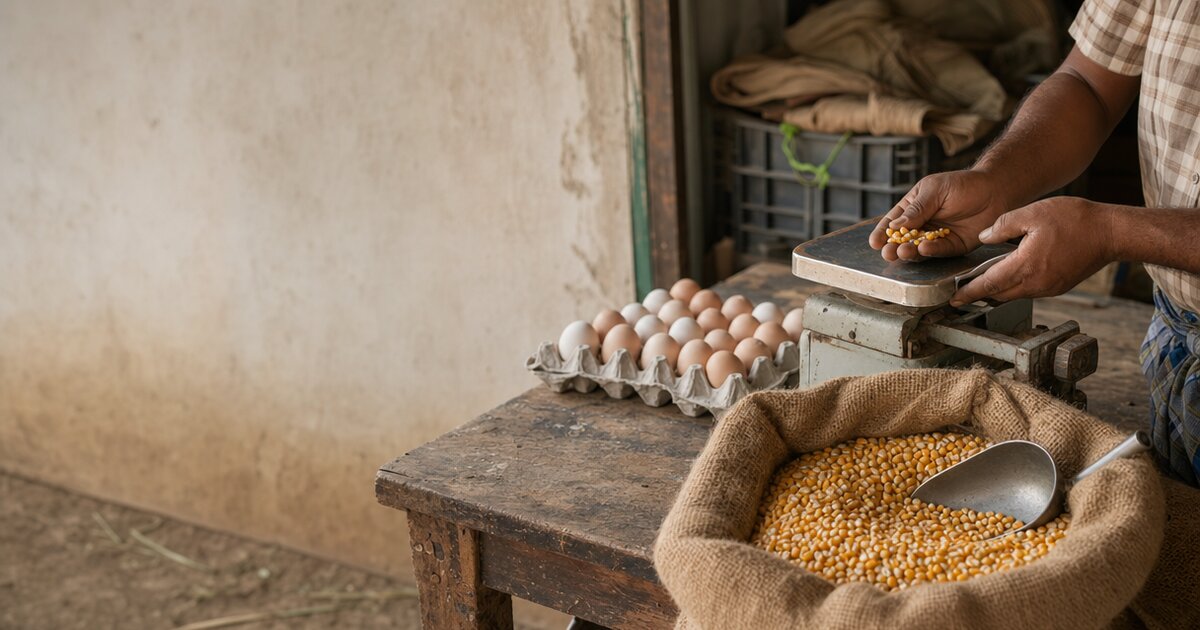
An egg line on a Chennai kitchen’s purchase sheet looks simple: number of trays multiplied by the landed rate. Behind that rate sits a longer chain—maize, soymeal, feed milling, a laying farm, transport and the local market.
India’s E20 programme now reaches into that chain because distilleries and feed mills can be buyers of the same maize crop. That competition can raise feed pressure. It cannot, by itself, tell us how much of today’s egg quote came from ethanol.
The four-link chain from fuel to a tray
Test the ethanol claim one link at a time.
| Link | What is established | What is not established |
|---|---|---|
| Ethanol programme → maize demand | Maize is an approved ethanol feedstock with administered procurement terms | That every distillery uses maize in the same proportion |
| Maize demand → poultry feed | Maize makes up roughly 50–55% of poultry feed, according to the current industry estimate cited below | That maize is the only feed input moving |
| Poultry feed → egg production cost | Feed is reported at about 65–75% of egg-production cost | That a feed increase passes through immediately or in full |
| Farm cost → your tray quote | Higher production cost creates upward pressure | That retail, transport, seasonality and local supply add nothing |
The two middle links are strong. In current reporting, the chairman of the Compound Livestock Feed Manufacturers Association of India put maize at about 50–55% of poultry feed. The same report places feed at roughly 65–75% of the cost of producing eggs, while also naming soymeal as another major input (India Today, 27 August 2026).
That is enough to say maize matters. It is not enough to say ethanol caused a particular shop price.
What the Economic Survey actually says
The strongest official warning is more careful than the social-media version. The Economic Survey 2025–26 says maize expanded for two reasons: productivity improved, and market incentives changed.
National maize yield rose from about 2.56 tonnes per hectare in FY16 to 3.78 tonnes in FY25. That makes the crop more attractive even without ethanol. But the administered price for maize-based ethanol also grew at an 11.7% compound annual rate from FY22 to FY25, faster than the prices for ethanol made from rice or molasses.
Over the same FY22–FY25 period, maize production grew at an 8.77% compound annual rate, while cultivated area grew at 6.68%. The Survey’s concern is not that maize output failed to grow. It is that an assured, feedstock-specific price can keep shifting land and investment toward maize, sometimes against pulses and oilseeds.
The egg question is not “food or fuel?” in one dramatic jump. It is whether maize supply is growing fast enough for feed and fuel at the same time.
A larger maize crop can serve more buyers. Pressure appears when the extra demand grows faster than available supply in a season, region or grade.
The government’s counterpoint matters too
The Petroleum Ministry’s 31 July 2026 clarification says ethanol producers switch among approved feedstocks according to availability. It reports that maize’s share of ethanol production fell from 42.6% in ESY 2023–24 to 35.96% in ESY 2025–26, while FCI rice reached 24.64% in the latter year after surplus stocks were released.
This weakens a claim that the programme is permanently locked to maize. It does not prove that maize demand from ethanol fell in tonnes. A share can fall while the total programme grows. The release gives feedstock shares, not the maize tonnage needed to assign a rupee amount to an egg.
The same release lists ₹71.86 per litre as the ESY 2025–26 procurement price for maize-based ethanol. That is the price of ethanol supplied to oil marketing companies. It is not the mandi price of maize and should not be quoted as one.
The two documents answer different questions. Flexible feedstocks can reduce dependence on maize in one ethanol year. Administered pricing can still create a durable competing buyer for the crop.
Why one cause cannot explain every egg rate
Egg prices are discovered locally and move through production and consumption centres. Even where maize is dearer, five other lines can change the final quote:
| Other moving line | How it reaches the egg price |
|---|---|
| Soymeal | A major protein input in poultry feed, with its own crop and processing market |
| Heat and disease | Both can affect laying performance, flock mortality and the number of saleable eggs |
| Flock decisions | Farmers may reduce or expand birds after weak or strong prices; supply responds with a lag |
| Seasonal demand | Institutional buying and household consumption do not stay flat through the year |
| Transport and trade margin | A Namakkal production-centre reference and a Chennai delivered or retail quote are not the same price |
This is why a national headline and a local invoice can appear to disagree. They may be measuring different weeks, markets and points in the chain.
Turn a tray movement into a menu decision
A kitchen does not need to settle national fuel policy before recosting an egg dish. It needs the current tray quote and the portion used.
The table below is scenario arithmetic, not a claim about today’s market.
| Increase on a 30-egg tray | Increase per egg | Increase in a two-egg dish |
|---|---|---|
| ₹15 | ₹0.50 | ₹1.00 |
| ₹30 | ₹1.00 | ₹2.00 |
| ₹45 | ₹1.50 | ₹3.00 |
Add oil, onion, masala, fuel, garnish, packaging and yield loss before judging the dish. Then divide the complete recipe cost by its selling price. The guide to food-cost percentage explains why the purchase bill alone is not the final ratio.
A ₹2 ingredient movement does not automatically require a ₹2 menu increase. The decision depends on the dish’s existing margin, sales volume, delivery commission and whether the rate has held long enough to recost rather than react.
A purchase check for the next quote
Keep four dated lines
Write the date, pieces per tray, grade if supplied, reference or delivered rate, and supplier. Do not compare a wholesale reference with a retail shelf price.
Where your supplier or producer can share it, record maize, soymeal and finished-feed direction separately. “Feed is up” is too broad to audit.
Divide the tray movement by the number of eggs, then multiply by eggs per dish. Add the other recipe lines before changing a menu.
A maize move should appear before feed and farm-cost pressure. A tray quote that moves without those lines may be responding to supply, demand or the local route instead.
For your own stock, purchase and sales numbers, the food-cost calculator keeps the COGS step separate from the explanation you give for one ingredient.
Frequently asked questions
Frequently asked questions
5 QDoes ethanol make eggs more expensive in India?
How much maize is used in poultry feed?
Is all ethanol in E20 made from maize?
Why can egg prices rise even when maize production rises?
How should a restaurant respond to a higher egg tray rate?
For more source-led explanations of how food prices and operations connect, browse Mikro’s food-industry articles.