
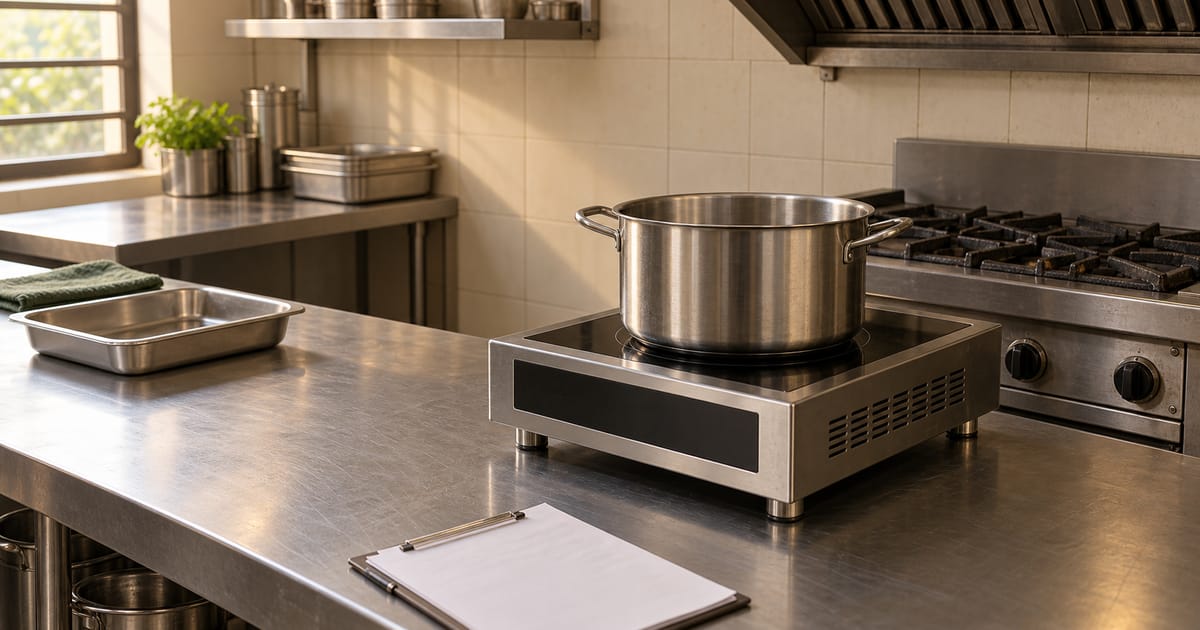
A pot that fits a demonstration hob may be too small for a Chennai meals kitchen’s lunch batch. Splitting that batch could still work. The question is whether the last portion reaches the pass before the orders pile up.
That is a better starting point than comparing the price of an induction cooktop with the next LPG refill. The cooktop has to earn a place in a working schedule, and the energy bill is only one part of that decision.
Choose a cooking duty before choosing a stove
“Switch the kitchen to electric” is too broad for a useful trial. Start with a repeatable job: a scheduled sauce batch, a breakfast preparation or a particular finishing station. Write down its normal output and when service needs it.
Keep the trial narrow enough that a failure has a name. An undersized vessel, a slow recovery between batches and an unacceptable finished texture need different corrections.
| Trial question | Evidence to keep | What a demonstration can miss |
|---|---|---|
| Can it make the food? | Accepted texture, portion size and recipe process | One attractive sample without a repeat batch |
| Can it make enough? | Saleable portions ready by the required time | A small pot finishing quickly |
| What does it consume? | Metered electricity or measured LPG for the same duty | Rated power treated as continuous consumption |
| Can this kitchen run it? | Equipment requirements and an installation assessment | Other equipment running during lunch |
| What does the change cost? | Equipment, pans, installation and recurring costs | The appliance sticker price alone |
June 2026 reporting from Jaipur described hoteliers adding electric equipment after LPG disruption while retaining some gas cooking and backup. That is useful context for a mixed kitchen. It does not establish a national adoption rate or the savings available at a Chennai property.
Read the conditions behind a savings claim
The MECS Multifuel Study: India, published in March 2026, compared LPG with several electric appliance types across six common Indian dishes. Its appliance selection and recipe quantities were household-oriented. It was not a restaurant service trial.
The cost calculation used ₹5 per kWh for electricity and ₹852 for a 14.2 kg LPG cylinder. These are the study’s assumptions on PDF page 11, not current commercial rates. Its boiling and steaming recipes used quantities suitable for a family of four, as page 12 explains.
For a purchase manager, those boundaries matter more than borrowing the headline saving. A kitchen with a different tariff, vessel size and required output needs its own comparison. The research gives a reason to investigate; it cannot supply the property’s result.
Compare consumed energy for the same output
Use a batch boundary that both methods can meet. If the electric route needs several smaller batches, include all of them. Keep ingredient quantities, starting conditions, finished quality and the required ready-by time as comparable as the approved recipe permits.
The arithmetic is straightforward:
Electricity cost = measured kWh × applicable ₹ per kWh
LPG cost = measured LPG kg × invoiced ₹ per kg
Energy cost per accepted portion = complete duty’s energy cost ÷ accepted portions
A kW rating describes power; the meter’s kWh reading describes energy consumed across the trial. Do not multiply the maximum rating by the whole shift and present that as measured usage. Equally, do not omit preheating, repeated batches or holding that belongs inside the agreed duty.
Have a competent technician arrange metering suitable for the equipment and supply. Ask the gas supplier or kitchen service team for a safe LPG measurement method. Staff should not disconnect or improvise fuel connections to weigh a trial.
Use the property’s actual commercial electricity bill and LPG invoice. Keep any extra fixed or demand charges caused by the change separately visible; the per-kWh calculation alone will not capture them. If the trial cannot isolate energy use reliably, label the result an estimate and keep that uncertainty in the decision.
The denominator deserves equal attention. A batch that makes fewer acceptable portions has a different cost even if its energy reading falls. The same whole-batch discipline appears in our guide to tea cost per cup, where saleable yield decides how much cost each cup carries.
Check the pans and the installation together
“Induction compatible” is a starting point, not a complete equipment match. The actual vessel needs to suit the selected unit’s permitted base, dimensions and loading conditions. A pan that works on a small test hob does not prove that a larger vessel will work on the purchased model.
For example, Hatco’s IRNG-HC1 installation and operating manual requires a dedicated circuit and specifies suitable pans and installation clearances. Those are requirements for that equipment family. They are not an Indian wiring specification or an endorsement of a particular purchase.
Before ordering, give the installer the proposed equipment schedule and the kitchen’s existing loads. The review should cover the available supply, sanctioned load, protective arrangements, connection requirements and space for the manufacturer’s cooling clearances. Ask for the installation cost with the equipment quote, so an affordable hob does not arrive before its supply is ready.
Test the lunch queue as well as the batch
A quiet demonstration answers whether a machine can cook. A service trial answers whether the kitchen can depend on it.
Record when each batch starts, when it becomes acceptable and when the station is ready again. Include loading, unloading and necessary cleaning. Check who must attend the job while other orders are waiting; an extra appliance does not create another pair of hands.
If the proposed replacement requires several batches in sequence, put their completion times beside the service requirement. The scheduling problem is similar to planning bakery production: quantity, equipment capacity and ready-by time have to agree.
Keep the kitchen’s approved food-safety process intact during the trial. A shorter cycle counts only if the finished food remains acceptable and the validated process permits it. Record delays and rejected output instead of removing them from the comparison.
A lower batch cost is useful only if the batch arrives when service needs it.
Decide the outage plan before retiring existing capacity. List which duties can move to approved backup equipment, at what output, and which menu items would pause. Do not assume the building’s backup supply can carry the new cooking load; that belongs in the installation assessment.
Make a decision small enough to verify
A successful trial can justify moving one duty first. It need not become a claim that every burner should go. The trial may also show that a different vessel, another appliance type or a revised preparation schedule deserves a separate test.
Close the trial with a decision record
Record the recipe, accepted output, vessel and required service time. Keep a clear baseline for the current method.
Obtain the selected model’s requirements and a qualified installation assessment. Include pans, connections and service support in the quote.
Compare complete duties, with energy, accepted yield, staff attention and completion time recorded. Keep failed or delayed runs in the record.
State which duty can move, what investment it needs and how backup works. Recheck the result after ordinary service before expanding the change.
Keep energy savings in the operating-cost review. They do not directly reduce ingredient food-cost percentage. Review that percentage separately, then bring energy, labour and equipment costs together when judging the kitchen’s overall result.