
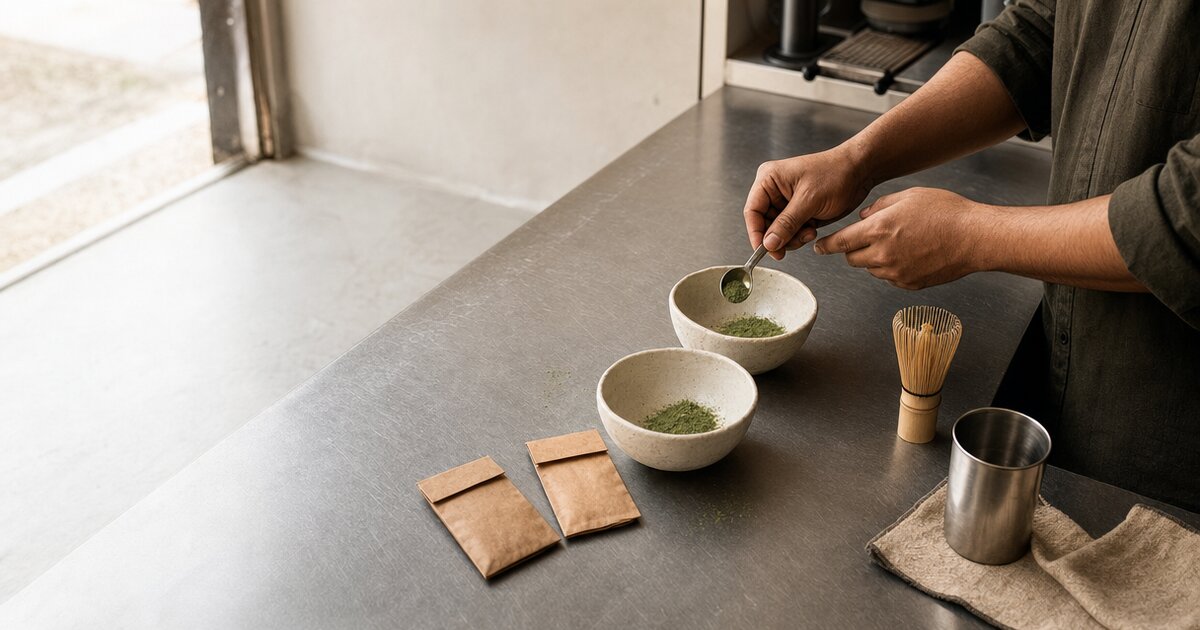
A cafe buyer now has a new line to put beside Japanese matcha on a sample sheet: made in Assam. The colour may be green in both bowls. That alone settles nothing. The useful questions are what happened to the leaf before grinding, how the powder behaves in the actual drink, and whether the next lot will match the first.
On 3 July 2026, the Indian Express reported that a five-kilogram batch from Chota Tingrai Tea Estate in Tinsukia was sold through the Guwahati Tea Auction Centre. It was reported as India’s first commercially manufactured matcha. That is a real production milestone. It is also a very small beginning.
What turns green tea into matcha
Matcha is not ordinary green tea put through a grinder. The raw material is tencha: leaves grown under cover, steamed and dried without the rolling used for sencha. Stems and veins are removed before the prepared leaf is milled into powder.
Japan’s Ministry of Agriculture, Forestry and Fisheries describes that route in its official Uji tea production guide. The geography explains a tradition and a body of skill. The process explains the product.
| Stage | Matcha route | Why the buyer should care |
|---|---|---|
| Cultivation | Tea bushes are shaded before harvest | Changes leaf colour, bitterness and umami |
| Primary processing | Leaves are steamed and dried without rolling | Produces tencha rather than an ordinary rolled green tea |
| Sorting | Stems and leaf veins are removed | Affects texture and the material sent to the mill |
| Finishing | Tencha is cut, dried and ground into fine powder | The whole prepared leaf becomes the drink |
This gives an Indian producer a clear technical route. It also gives an Indian buyer a better question than “Is it from Japan?” Ask whether it was made from shade-grown tencha and how that tencha was processed.
Five kilograms proves capability, not supply
The Tea Board of India reported 1.54 million kilograms of green tea in April 2026 across the country. That official category includes green tea generally; it does not identify matcha. Put beside that national production number, one five-kilogram matcha lot should be read as a commercial trial, not as evidence that Indian cafes can now replace imported supply.
That distinction protects a promising story from being overclaimed. The lot shows that an Assam estate established the cultivation and factory steps well enough to take a product to auction. It does not tell us how much tencha the estate can make next season, whether sensory quality will repeat, how powder will hold after opening in a humid kitchen, or what regular wholesale terms will look like.
The first lot answers “can India make matcha?” The next lots must answer “can a buyer rely on it?”
There is a wider supply signal, although it needs careful labelling. JETRO reported that Japan exported 12,612 tonnes of green tea worth ¥72 billion in 2025. Quantity rose 43.3% from 2024; value rose 98.2%. This is a green-tea series, not a matcha-only series, but the gap between volume and value shows why international buyers are looking hard at supply and price.
Will Indian matcha make a cafe cup cheaper?
Possibly, later. The first auction cannot answer that question.
Mint’s August 2026 reporting put good culinary or latte-grade matcha bought by Indian cafes at ₹6,000–10,000 per kilogram, and ceremonial-grade powder at ₹15,000–20,000 per kilogram. Those are reported buyer bands, not an official average. At a measured two-gram dose, the powder arithmetic is:
| Reported powder band | Cost per gram | Powder in a 2 g drink |
|---|---|---|
| Culinary or latte grade: ₹6,000–10,000/kg | ₹6–10 | ₹12–20 |
| Ceremonial grade: ₹15,000–20,000/kg | ₹15–20 | ₹30–40 |
Milk, sweetener, ice, cup, labour, rent, payment charges and wastage still sit outside those numbers. So does the difference between an auction price, an importer’s landed cost and a cafe’s delivered price. The Indian Express describes ₹3,000 as the five-kilogram batch’s sale value, while NDTV reports ₹3,000 per kilogram. That conflict is enough reason not to use the figure as a cafe-cost benchmark.
A domestic supply chain could remove some freight, currency and import exposure. It can also add new costs: smaller production runs, specialised shading, dedicated processing, fine milling, testing and packaging that keeps the powder dry and fresh. Local is not automatically cheap. At this stage, consistency is the more useful promise to test.
For a cafe, a kilogram quote is only the start. The existing guide to tea cost per cup shows how to cost the complete batch and the cups actually sold. The related food-cost percentage guide explains where that drink contribution sits inside the wider business.
Buy the use case, not the adjective
“Ceremonial”, “premium”, “latte grade” and “single origin” may help a seller describe a range. They do not replace a buyer specification. A milk drink can hide some fine aroma while exposing bitterness. A bowl made with water is less forgiving.
A bakery powder needs colour and flavour that survive fat, sugar and heat. That is a different job from either drink.
Before comparing samples, write down the job:
- straight matcha prepared with water;
- an unsweetened or sweetened milk drink;
- a cold drink where dilution continues as ice melts;
- a dessert or bakery application;
- a retail powder that will spend weeks after opening with the customer.
Then ask the supplier for origin, harvest or lot, tencha process, recommended dose, pack size, storage conditions and a certificate of analysis where the business requires one. None of these documents can decide whether the drink tastes right. They make the tasting repeatable and the next purchase easier to compare.
Run a small cafe trial
One use case, two samples
Fix one cup size, milk, sweetener, ice level and service method. Do not compare powders in two different recipes.
Test two measured doses for each sample. Record whisking or mixing time, clumping and the finished yield.
Code the cups so staff or a small tasting panel does not know which origin or price they are judging. Record bitterness, aroma, colour and finish.
Compare rupees per accepted cup, not rupees per kilogram. Replace the example rates with the actual recipe in the free food cost calculator.
Store both powders as instructed and repeat the same drink. The first cup tests a sample; the later cup tests the working pack.