
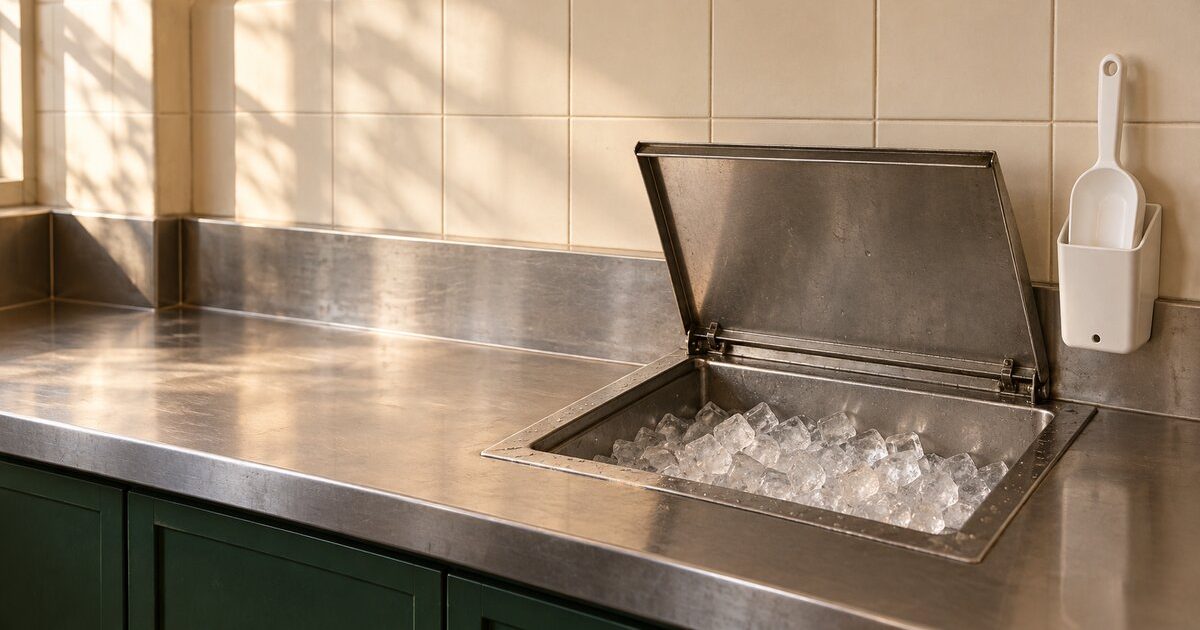
At a Chennai beverage counter, the scoop has to go somewhere between orders. That small storage decision sits downstream of the water filter, the laboratory report and the ice machine. A clean supply does not settle what happens when a handle disappears into the cubes or a transfer bucket returns from another job.
Follow the ice through the outlet once. The useful question is what touches it after it forms, and who is responsible for keeping that route fit for service.
What the water test actually covers
FSSAI’s Schedule 4 requires ice in direct contact with food to come from potable water and to be produced, handled and stored without contamination. The provision is in Part II, section 4.4. Part V’s introduction makes the Part II requirements applicable alongside the catering-specific provisions for licensed establishments.
The April 2025 catering inspection checklist makes the water check concrete: item 8 specifies potable water meeting IS 10500, semi-annual testing and retained records for ingredient and food-contact use. That is a water-testing requirement. It does not establish a universal laboratory-testing interval for finished ice.
Keep the report connected to its actual sampling point and date. A report for incoming water leaves a different question from a sample taken after the outlet’s storage and treatment system. Ask the food-safety lead and testing laboratory to define the sampling plan for the actual installation.
If the only result available is from a handheld meter, our cafe water and TDS explainer explains why that reading cannot establish potability. Clear cubes and a reassuring meter display are not substitutes for the required assessment.
Here is a proposed outlet review sheet. It separates the decisions so that a tick beside “water checked” cannot close every row.
| Contact point | What to check | What to keep on the record |
|---|---|---|
| Water entering the ice system | Supply, treatment and relevant test report | Sampling point, date and report reference |
| Machine and storage bin | Condition and completion of the applicable cleaning procedure | Machine identity, work completed and person responsible |
| Bought-in ice | Approved source, pack condition and delivery traceability | Supplier, delivery and lot details where supplied |
| Transfer container | Suitability for food contact and protected use | Assigned purpose and cleaning responsibility |
| Serving scoop and well | Clean utensil, protected storage and no unrelated contents | Opening check, exception and corrective action |
The sheet is an editorial workflow suggestion, not an FSSAI form. A small counter can keep it with the existing opening record instead of creating another folder nobody uses.
Keep serving ice on a dedicated route
FSSAI’s Basic Catering training manual specifies a food-grade plastic scoop and a clean ice machine, alongside hygienic handling to avoid cross contamination. It is training guidance aimed at registered catering businesses; it should not be described as a new rule issued this year.
Choose a protected, clean place for the scoop between uses. Make the arrangement obvious enough that a relief worker can follow it without hunting for the usual person. If the handle can end up buried in ice, the storage arrangement needs attention.
The US FDA’s packaged-ice guidance recommends clean, non-breakable utensils and food-safe containers, and warns against contact with dirty hands or glasses. These are useful handling principles, not a statement of Indian licensing law. A drinking glass makes a poor substitute for the designated scoop.
Keep the drinks well separate from ice used to chill bottles or other packages. The FDA Food Code, section 3-303.11, explicitly excludes ice used to cool exterior surfaces from later use as food. The practical distinction is easy to explain at a bar: cubes surrounding a bottle have had a different contact history from cubes reserved for the customer’s glass.
For off-site catering, include the journey from the kitchen to the service station in the review. A dedicated container still needs a suitable lid and a clean route through loading, transport and unloading. Our food-contact packaging explainer covers the next purchasing question: whether the exact material is suitable for its intended use. The words “food grade” alone do not describe every use condition.
Descaling does not complete the cleaning job
A service invoice saying “ice machine cleaned” is too vague to tell the next manager what was done. Ask for the installed model and the procedure used, then distinguish scale removal from sanitising the food-contact system.
In its original KM machine training guidance, Hoshizaki explains that descaling chemicals do not perform the sanitising job. It also instructs users to remove ice before chemical cleaning and warns against mixing cleaner and sanitiser. The detailed sequence belongs to the model’s documentation.
That distinction matters more here than borrowing a calendar interval from an unrelated machine. Water conditions, equipment design and the manufacturer’s instructions affect the maintenance plan. A clean exterior does not prove the internal work was completed.
The outlet record can be short: which machine, which procedure, who completed it, and whether it was released back to service. A named responsibility is more useful than a general reminder to “maintain hygiene”.
Make a problem visible before the next order
Bought-in ice needs a receiving decision too. Agree the intended food use and supplier documentation before the rush, then check the actual delivery. Keep the pack and lot information available if there is a problem. The broader chilled-food receiving guide explains how condition and traceability checks fit together; its product-temperature examples are not a finished-ice testing specification.
A shift handover should also distinguish “nothing unusual seen” from “all required work completed”. Visual inspection can find a dirty scoop, foreign material or an unprotected container. It cannot certify microbiological safety.
A workable opening and handover routine
Identify the in-house machine or bought-in supply being used. Keep the relevant water, supplier and maintenance records accessible to the person opening the counter.
Review the transfer container, serving well and scoop storage. Give each a defined purpose and a person responsible for the required cleaning.
If contamination is suspected, stop using the affected ice and keep it out of service. Follow the outlet’s food-safety procedure for disposal, cleaning and release; arrange an approved backup supply where needed.
For an event counter, make that backup decision before guests arrive. The person serving drinks should know whom to call and which supply has already been approved. Otherwise a correctly identified problem becomes a hurried sourcing decision at the busiest point in service.
The water report cannot sign off the serving scoop.