
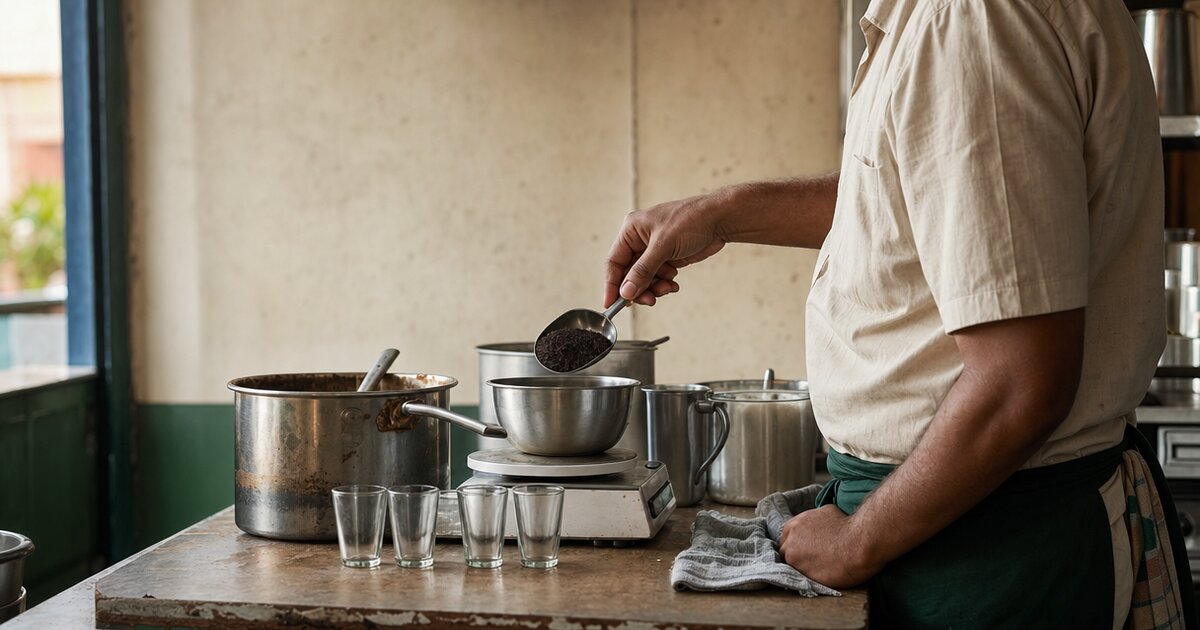
At a Chennai tea counter, the one-kilogram tea packet has a visible price. The last half-pan of tea does not. Some batches sell cleanly; another leaves two cups at closing. The cost per cup lives in that difference.
The calculation is straightforward:
Cost per sold cup = liquid batch cost ÷ cups actually sold + serving cost
Milk, tea powder and sugar belong in the liquid batch. So do ginger or masala, filtered water and the fuel used to heat it. A disposable cup is a serving cost. For steel or glass tumblers, use a small cleaning and breakage allowance instead.
The one formula that matters
Start with one normal batch, not a monthly purchase total. Record what went into the pan and what came out through the till.
| Line to record | How to cost it |
|---|---|
| Milk | Litres used × your invoice rate per litre |
| Tea powder | Grams used ÷ 1,000 × rate per kg |
| Sugar | Grams used ÷ 1,000 × rate per kg |
| Ginger, masala or flavouring | Actual batch quantity × purchase rate |
| Water and heat | Measured or reasonable batch allowance |
| Saleable yield | Cups sold, not cups the recipe was expected to make |
| Serving cost | Disposable cup and lid, or cleaning/breakage per reusable glass |
The ingredient column is only half the sheet. If a batch should fill 12 cups but only 10 are sold, the tea in the discarded two cups is carried by the 10 customers who paid.
This batch sheet answers a narrower question than a monthly food-cost report. Once the cup number is reliable, Mikro’s free food cost calculator can connect purchasing, stock counts and sales across the whole business.
A worked batch, with every assumption visible
The following is an example worksheet, not a Chennai market benchmark. The tea and sugar rates are Mikro’s public rates observed on 23 August 2026. Every other input is deliberately marked for replacement with the operator’s own invoice, recipe or meter reading.
| Batch input | Quantity | Rate used | Batch cost |
|---|---|---|---|
| Milk | 1 litre | ₹60/L (example; replace) | ₹60.00 |
| AVT Gold Cup tea | 20 g | ₹595/kg (dated public rate) | ₹11.90 |
| Sugar | 120 g | ₹74/kg (dated public rate) | ₹8.88 |
| Ginger or masala | One batch | ₹4 (example; replace) | ₹4.00 |
| Filtered water and heat | One batch | ₹3 (example; replace) | ₹3.00 |
| Liquid batch cost | ₹87.78 |
If that batch produces and sells 12 cups, and each disposable cup costs an example ₹0.80, the calculation is:
₹87.78 ÷ 12 + ₹0.80 = ₹8.12 per sold cup
At a ₹15 selling price, the contribution is ₹6.88 per cup before rent, labour and the other operating costs. Change the selling price, milk rate, recipe, cup size and yield to the values at the actual counter. The worksheet is useful because every assumption is exposed; the ₹8.12 itself is not a benchmark.
Wholesale rates move. Use today’s Chennai price list before repeating the calculation, and check the current AVT Gold Cup product page rather than carrying this dated rate into a later month.
These are the counter inputs from this worksheet that we stock, at the rate current when this page was built:
| Product | In the batch sheet | Rate |
|---|---|---|
| AVT GOLD CUP TEA 1 KG | The worked batch's powder, costed at a measured 20 g dose | ₹595 |
| 3 ROSES TEA 1kg 3 ரோசஸ் 1 kg | The comparison powder in the dose table below | ₹720 |
| SUGAR 1st சக்கரை | 120 g per example batch | ₹60 |
| 90ML BIO TEA CUP ROLL | Disposable serving cost for a standard small tumbler | ₹28 |
| 110ML BIO TEA CUP ROLL | The larger serving size, if that is what the counter pours | ₹42 |
Two unsold cups change the number
Now keep the same ₹87.78 liquid batch but sell only 10 cups. Perhaps demand softened after the office rush. Perhaps the final cups sat too long to serve. The reason belongs in the waste log; the arithmetic is the same.
₹87.78 ÷ 10 + ₹0.80 = ₹9.58 per sold cup
Nothing changed in the recipe or packet price. Losing two saleable cups added ₹1.46 to the variable cost carried by every cup that did sell.
That is why “we use one packet every few days” cannot establish a margin. A packet count sees purchasing. It misses over-boiling, free staff cups, spills, wrong cup fills and the balance discarded at the end of a slow period.
The packet rate prices the powder. The batch sheet prices the cup.
Record the causes separately. A staff cup is not the same problem as a spill. A test batch is not the same as a closing discard. Lumping all four into “waste” produces one depressing number and no decision.
Food safety comes first. The FSSAI catering-sector guidance covers storage, time and temperature control, and FIFO/FEFO stock rotation for restaurants, cafes, kiosks and caterers. A margin calculation is never a reason to extend the life of a milk-based batch beyond safe handling practice.
Tea powder price is only one lever
A one-kilogram packet price is easy to compare. For cup costing, dose and saleable yield have to travel with the packet rate.
At the public rates observed on 23 August 2026:
| Tea powder | Dated rate | Cost of a 20 g example dose | At 12 sold cups |
|---|---|---|---|
| AVT Gold Cup Tea 1 kg | ₹595/kg | ₹11.90 | ₹0.99/cup |
| 3 Roses Tea 1 kg | ₹720/kg | ₹14.40 | ₹1.20/cup |
| Difference | ₹125/kg | ₹2.50/batch | ₹0.21/cup |
This is a procurement comparison, not a taste verdict. Equal grams do not guarantee equal colour, strength or customer acceptance. If a higher-priced powder produces the required cup at a lower dose, the packet comparison can point in the wrong direction.
Run a controlled taste-and-yield check: same milk, sugar, cup and method; only the tea and measured dose change. Cost the accepted recipe, not the cheapest kilogram.
Tea Board India’s 2024-25 annual report reports that roughly 84% of India’s 2024 tea production was consumed within the country. A roadside stall, office canteen and hotel beverage counter do not share a serving size, recipe, rent or service model. They cannot share one useful national “profit per cup” figure either.
Contribution is not the money left at month-end
A cup can show a healthy contribution and the shop can still lose money. The gap contains costs that do not rise neatly with each cup:
- wages and the owner’s working time;
- rent, electricity and water beyond the batch allowance;
- licences, pest control and cleaning;
- refrigerator, stove, boiler and utensil repairs;
- payment charges, discounts and aggregator fees where relevant;
- unsold snacks or other items sharing the same counter.
Use the per-cup sheet to control the recipe and service. Use weekly stock and sales to judge the business. The related guide to food-cost percentage in India explains why purchases alone are not cost of goods sold and why the stock count must sit between them.
Run a seven-day cup-cost test
One week, one repeatable method
Weigh milk, tea powder, sugar and additions. Record the intended cup size. “Two spoons” is not a standard until the spoon and weight are fixed.
Convert every ingredient to a batch cost. Add the disposable cup, or a realistic cleaning and breakage allowance for reusable service.
Separate sold cups, staff cups, samples, spills and closing discard. The total explains yield; the categories explain what to change.
Divide liquid batch cost by cups sold, then add serving cost. Compare the result with selling price to get contribution, not profit.
After seven ordinary days, choose the largest repeatable leak. Adjust one dose, batch size, brew timing or service control and measure another week.