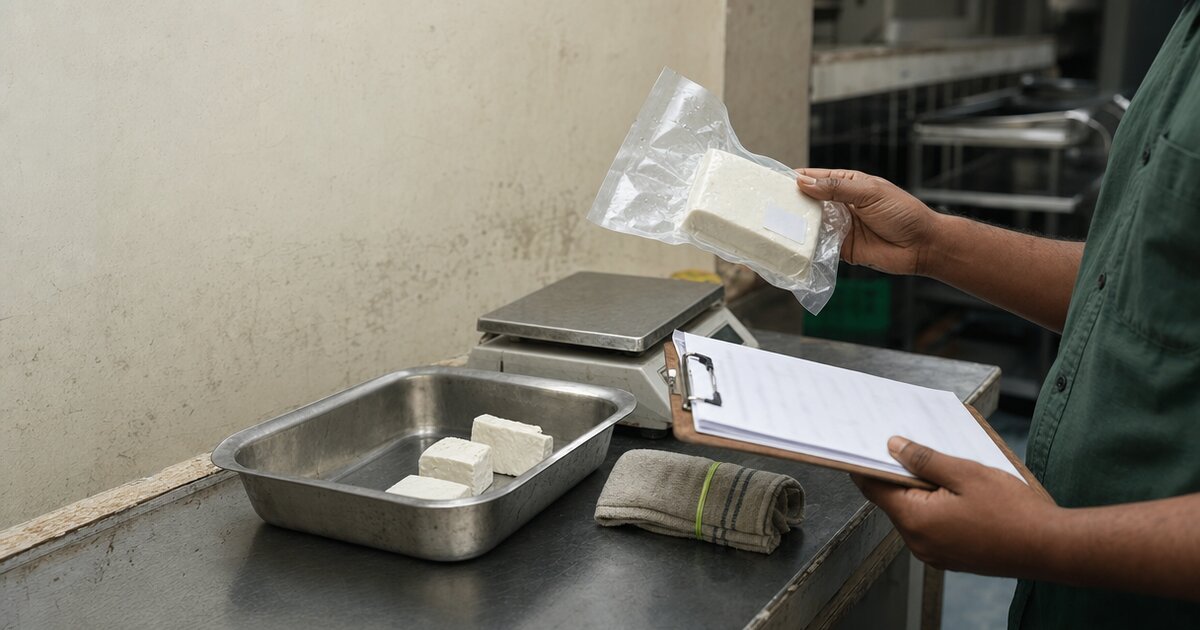
A white block reaches a restaurant receiving counter. The invoice says “paneer”, the outer bag says little, and the landed rate is far below the buyer’s usual quote. Colour and firmness will not settle what it is. The useful questions are on the specification, pack and invoice: what is the product actually called, which ingredients replace milk constituents, and what did the supplier guarantee in writing?
On 28 August 2026, paneer appeared in Google’s daily India Trends feed amid reports of fresh state restrictions. The national rules, a regional FSSAI enforcement notice and state bans are related, but they are not the same thing.
Three different products get called “fake paneer”
The phrase is emotionally clear and technically messy. It can hide three different situations.
| What is in front of you | What the name should communicate | The practical issue |
|---|---|---|
| Dairy paneer | Paneer or the applicable fat-class name under the dairy standard | It must match the declared dairy identity and composition |
| Analogue in the dairy context | A non-dairy or analogue identity that makes the substitution clear | It must not be passed off as paneer |
| Product sold as paneer but containing undeclared non-milk substitutes | The invoice and sale description are false or misleading | This is an identity, traceability and possible safety failure |
FSSAI’s 2025 consultation paper on dairy analogues quotes the underlying regulatory definition. An analogue is a product in which something not derived from milk takes the place, partly or wholly, of a milk constituent, while the result resembles a milk product in use or sensory character.
That definition covers more than one recipe. It does not prove that every analogue contains the same oil, starch, protein or emulsifier. The ingredient list and product specification still matter.
What FSSAI has actually said
The central principle is older than this month’s headlines: a food that is not a milk product should not be presented in a way that suggests it is one. The 2025 consultation paper also proposed clearer pack declarations and explicit menu wording for dairy analogues. Those proposals were presented for comment; they should not be mistaken for a final ban notice.
A later document is more direct. On 21 April 2026, FSSAI’s West Region issued an enforcement notice for centrally licensed manufacturers and food-service establishments. It says selling cheese analogue to a food-service establishment as paneer is a grave violation. It directs procurement teams and chefs to watch incoming raw material, retain records, use regular verification and testing, and display the use of cheese analogue on menus or boards.
Two summaries now circulating overstate the evidence. “FSSAI has banned every dairy analogue nationally” is broader than the cited notice. “Analogue paneer is fine everywhere if the label is honest” ignores the newer state-level prohibitions.
Punjab is the most recent example. A 27 August 2026 report on the state’s one-year order says 512 samples were analysed from 1 April 2025 to 31 March 2026; 215 were non-conforming, including 156 substandard and 59 unsafe samples (Times of India). That works out to roughly 42%, as the reported order states. It is a Punjab enforcement sample, not a survey of all paneer sold in India.
Punjab’s order shows how state action can go beyond the national naming and display baseline. A Chennai operator should check the current Tamil Nadu Food Safety position before buying or listing a dairy analogue. A national headline is not a local legal sign-off.
The invoice is part of the food-safety file
The April notice quotes Section 26(4) of the Food Safety and Standards Act: when one food business sells to another, the bill, cash memo or invoice can serve as the written guarantee about the article’s nature and quality.
That turns a routine purchase document into evidence. “White block, 10 kg” is not an adequate line when the kitchen ordered paneer. The invoice should carry the actual product identity, and it should agree with the pack, supplier specification and menu description.
If the order says paneer, the pack says analogue and the menu says paneer, the problem is already visible before a laboratory opens the sample.
Price can trigger a closer look, but it cannot identify the product. A cheap rate may come from pack size, shelf-life pressure, milk supply, quality or an undisclosed substitution. A high rate is not proof of dairy paneer either. Re-cost the recipe only after the identity is settled; the guide to food-cost percentage shows where the landed ingredient rate enters the wider dish calculation.
A receiving check that does not rely on kitchen myths
Online advice often recommends an iodine test, a frying test or judging how a cube squeaks. These may reveal one property in one formulation. They cannot prove that the product meets the paneer standard, identify an undeclared fat, or replace a notified laboratory method.
Use documents and controlled verification first.
Check paneer at receiving
Write the required identity plainly: dairy paneer, not “paneer-type product” or a generic white block. Reject an invoice line that does not match what was ordered.
Match the product name, ingredient list, manufacturer, FSSAI licence, batch or lot, dates and storage instructions to the supplier specification. Record any non-milk constituent replacing a milk one.
Retain the invoice and batch details with the goods-received record. If a complaint arises, “we buy from the usual person” is not a traceable lot.
Escalate ambiguous, loose or mismatched material. Where risk and volume justify it, use a recognised food laboratory and the applicable sampling procedure rather than a viral home test.
The ingredient identity in procurement, recipe cards, staff training, bills and menu display should agree. Recheck the current rule for every state in which the business operates.
Paneer sits inside a wider menu-disclosure problem. Restaurants already manage several disclosures depending on licence and format. The explainer on calories, serving sizes and allergens on Indian menus shows why the exact scope matters more than a blanket social-media summary.
What a diner can reasonably ask
A diner cannot inspect the receiving file from the table. They can ask one plain question: “Is the paneer in this dish dairy paneer or an analogue?” A clear answer and matching menu description are more useful than guessing from texture or price.
Do not treat every unfamiliar texture as fraud. Moisture, fat class, pressing, storage and cooking all change paneer’s bite. If identity matters for an allergy, dietary choice or nutrition plan, ask for the product information; do not rely on appearance.
Nutrition claims need the exact pack too. Paneer and an analogue can have very different protein, fat and energy values, but there is no single nutrition profile for every analogue. Read the declaration for the actual product rather than borrowing a number from another pack.
Frequently asked questions
Frequently asked questions
5 QIs analogue paneer real paneer?
Is analogue paneer banned in India?
Is analogue paneer the same as adulterated paneer?
How can a restaurant check whether paneer is genuine?
Can restaurants serve analogue paneer if they disclose it?
For more source-led explanations of food-industry questions, browse Mikro’s English articles.