
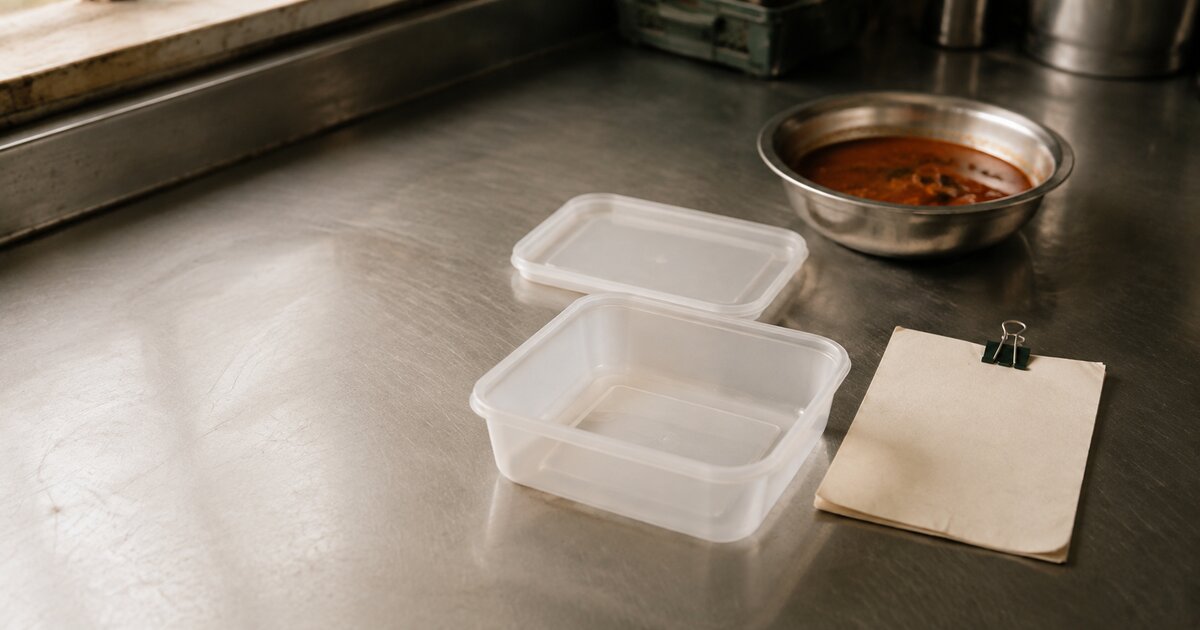
A takeaway container sample on a Chennai kitchen pass has a specific job: hold the food, close properly and survive the delivery. Its supplier may also offer a document headed “food grade”. Before ordering, the buyer needs to connect those two things. Which material does the document cover, and under what conditions will this kitchen use it?
The question has fresh attention. The Packman’s report of 4 September 2026 describes FSSAI scrutiny of food-contact packaging and a planned national surveillance exercise from November. That is reporting of a plan, not a new compliance deadline for restaurants. The purchasing duties already exist.
Food grade means suitable for the intended use
The FSSAI Packaging Regulations compendium, Version V of 2 April 2025 defines food grade through safe, suitable intended use. Regulation 3 also requires compatibility with the product, storage, filling and sealing equipment, and transport conditions. A material name by itself cannot answer all of those questions.
For a purchase specification, translate the menu into conditions the supplier can assess. The table below is a proposed buying record, not an FSSAI form.
| Specify this | What to put in the request | What it helps establish |
|---|---|---|
| Food and contact surface | Actual dish; container, lid, liner or coating that may touch it | Which materials need supporting evidence |
| Filling and holding | Actual fill temperature, holding time and storage conditions | Whether the declared use covers the kitchen’s process |
| Closure | Exact lid or sealing film and equipment, where used | Whether the complete pack closes as intended |
| Delivery | Carrying position, stacking and expected journey conditions | Whether the pack withstands normal handling |
| Consumer use | Any proposed reheating or storage instructions | Whether those uses are supported by the specification |
| Identification | Manufacturer, material description and item or specification code | Whether sample, paperwork and reorder refer to the same pack |
A chilled dessert and a hot, oily gravy are different requests even if they fit the same-sized tub. Do not borrow a temperature limit from another supplier’s catalogue. Ask for the limit and conditions attached to the exact construction being offered, including its lid or lining where relevant.
The same caution applies to paper. A brown surface tells the buyer little about a coating or food-contact layer. “Eco-friendly” is a separate claim; it does not settle suitability for the proposed food. Neither should a plastic resin abbreviation be treated as permission for every filling or reheating process.
Match the certificate to the container
Regulation 3(14) says every food business operator must obtain the certificate of conformity issued by a NABL-accredited laboratory against the packaging regulations for the relevant food-contact material or layers. Asking the supplier to provide that document is a practical starting point. Receiving a PDF is only the start of reviewing it.
Keep the document beside the sample specification. Compare the manufacturer and material description, sample identification, tests and standards cited, results and any stated limitations. Where a supplier’s code differs from the laboratory’s sample code, ask for a clear written connection. An unrelated certificate in the same email does not close that gap.
Ask the supplier or issuing laboratory to explain which food-contact components the evidence covers. A container body and its closure may use different materials. The useful answer identifies the scope; it does not merely repeat that the supplier has always sold the two together.
Migration testing concerns substances transferred from packaging into food or food simulants. Overall migration and specific migration are different measures in the regulations. The relevant tests depend on the material and requirements; this is work for a competent laboratory, not something a buyer can infer from a clear-looking container.
SGS’s packaging migration guidance also describes testing across plastic and non-plastic materials and different markets. A foreign-market test reference therefore needs explanation against the applicable Indian requirements. It is not automatically the wrong evidence, but its relevance must be established.
This is the same purchasing distinction that matters when checking paneer identity: appearance and a familiar trade description cannot replace a traceable specification. If the supplier changes the material or manufacturing specification, ask whether the existing evidence still applies. Resolve that question before approving the substitute.
A delivery trial answers another question
Once the documentary review supports the intended use, a small operational trial can check whether the pack works on the outlet’s route. Use the actual food, fill level, closure and carrying arrangement. Record what happens at the kitchen pass and at the end of the expected journey.
Look for leakage, lid movement, loss of shape, wet outer packaging and damage under the intended stack. These are proposed practical observations. A successful trial provides evidence about handling performance under the conditions tried. It does not establish chemical migration compliance or approve a different material that looks identical.
A leak-free delivery proves something about the closure. It does not prove what the food-contact material releases into the food.
The distinction works both ways. A conformity document does not show that a rushed packer can seat a particular lid reliably, or that the chosen outer bag keeps the meal upright. Keep both records: conformity evidence for the material and an operational result for the complete pack.
Price comparisons should then use the complete approved pack. Include the required lid, liner, seal and outer carrier in the cost record. A quotation for the tub alone cannot be compared directly with an all-in pack. Keep this separate from ingredient food cost; the guide to food cost percentage explains which costs belong in that calculation.
Keep the approved pack recognisable at receiving
The review is useful only if the next delivery matches it. Give the person receiving packaging something simpler than a folder of laboratory reports: the approved supplier, pack code, description, closure combination and a sample or clear reference photo. Keep the supporting documents accessible to the person responsible for purchasing and food safety.
A workable approval and reorder routine
Record the food, filling and holding conditions, closure, transport and any proposed reheating use before asking for a quotation.
Obtain the conformity certificate and connect its material and sample identity to the pack being supplied. Refer unclear coverage to the supplier or issuing laboratory.
Trial the supported use and record closure and delivery performance. Keep this result separate from laboratory conformity evidence.
Put the approved specification on the reorder. If the body, lid, lining or supplier specification changes, review the change before use.
Protect packaging from dirt and damage in storage as well. The regulations require food to be packed in clean, hygienic, tamper-proof packaging. A conforming material can still arrive with crushed rims or be handled badly at the outlet; paperwork does not cancel those receiving checks.
Printed scrap paper is not a shortcut. The rules prohibit newspaper for storing and wrapping food and prohibit printed packaging surfaces from directly contacting food. A 5 June 2026 FSSAI advisory published by PIB reiterates that newspaper should not be used to absorb excess oil, cover food or wrap it. Replacing a purchased liner with newspaper changes the contact material, even if the outer box stays the same.
Disposal needs its own decision. A food-contact document does not answer where a used pack will be collected or processed. For the outlet’s wider waste obligations, the explainer on restaurant bulk waste generators separates general duties from threshold-based requirements.