
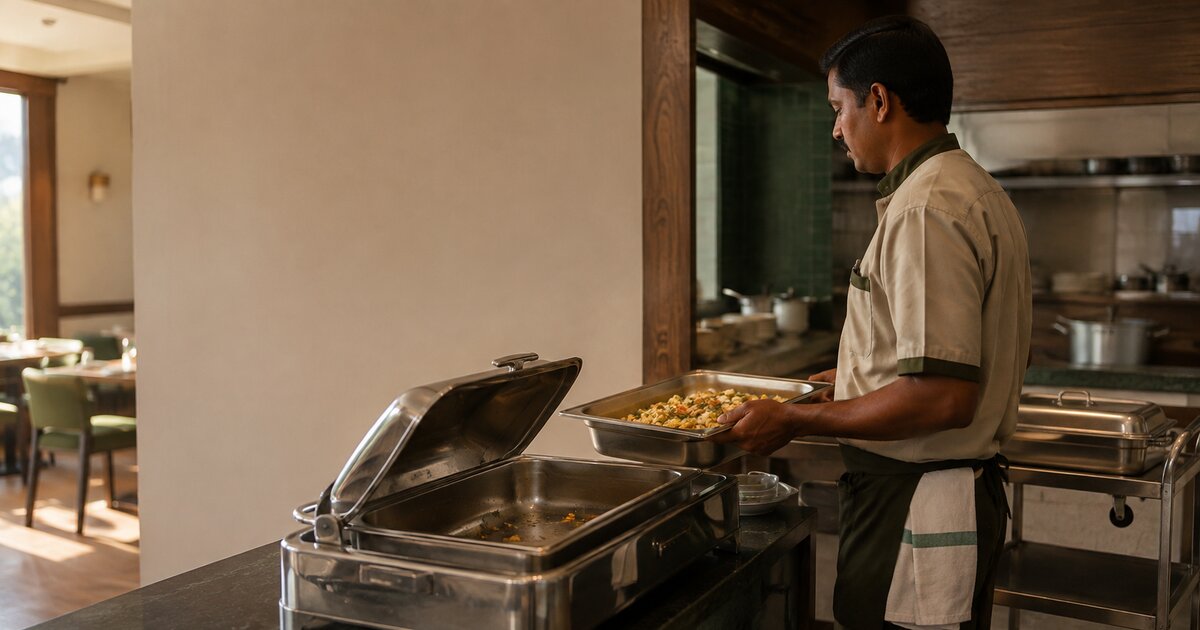
A breakfast steward lifts the lid on a nearly empty pan at 9:25. Service ends at 10. The kitchen has another full pan ready, a few guests are still coming down, and nobody wants the buffet to look abandoned.
Sending all of it out feels hospitable. Bringing most of it back 35 minutes later is the predictable result.
The better question is not, “What time should refills stop?” It is, “What is the smallest safe quantity this service is likely to use before closing?” A short refill sheet can answer that without software.
Why the last refill is hard
Hotels are selling an experience as well as breakfast. An empty pan can look like poor service even when only a few covers remain. The kitchen therefore protects itself against the visible failure — running out — by producing and displaying more than the line is likely to use.
A 2026 qualitative study interviewed nine culinary, food-service and general managers across eight three-star-or-higher hotels in India. The managers described fluctuating guest counts, fear of damaging the hotel’s reputation and reluctance to cook again late in service as reasons for overproduction. That is a small, purposive sample, not a national waste benchmark. It is still useful because it names the decision pressure at the buffet (Raju and colleagues, 2026).
The National Council for Hotel Management and Catering Technology points to smaller-batch cooking and live counters as responses to buffet leftovers in its current food-and-beverage management material. FSSAI’s Save Food, Share Food guidance is even more specific about the closing stretch: use smaller containers and consider a half-refill near the end of a buffet session.
Use five numbers, not one cutoff time
The last-refill decision needs five numbers that the restaurant manager, steward and kitchen already have.
| Input | What to record | Why it changes the refill |
|---|---|---|
| Remaining covers | Checked-in guests not yet served, plus known walk-ins | A late tour group is different from an almost-finished house |
| Recent pace | Portions taken in the last 15 minutes | The morning’s average hides the slowdown near closing |
| Food on display | Portions left in the current pan | A pan that looks low may still cover likely demand |
| Safe reserve | Portions ready but not yet displayed | This is the buffer the kitchen can release in small lots |
| Time to close | Minutes left in the service window | Each refill has less time to be eaten |
Pan size belongs beside those numbers. A 20-portion insert forces a 20-portion decision. A smaller insert or live counter lets the same kitchen release five portions, watch the line and cook again if needed.
A worked last-refill example
This is an illustrative calculation, not an industry benchmark. Suppose a hot item has moved four portions in the last 15 minutes. There are 35 minutes left, five portions remain on display and ten are safely held in the kitchen.
At the recent pace, expected use is about nine portions before closing:
4 portions ÷ 15 minutes × 35 minutes = 9.3 portions
The visible pan already holds five. The gap is roughly four portions, before the manager adjusts for known late covers. Sending a fresh 20-portion pan would be a poor default. A five-portion refill, with the remaining reserve held safely off the line, fits the evidence available at 9:25.
That arithmetic is deliberately modest. It will not predict the exact appetite of every guest. Its job is to replace a full-pan reflex with a reviewable decision.
The final buffet refill should be a measured release, not a fresh opening-day display.
Protect service without displaying the whole buffer
A smaller last refill is not permission to let the line look neglected. Give the steward a response ladder.
- Consolidate the food into a smaller clean insert when the service plan and food-safety procedure allow it.
- Refill one shallow batch and keep the remaining reserve under the kitchen’s time-and-temperature control.
- Move suitable items to live preparation late in service, where a guest can receive a fresh portion without a full pan waiting.
- Record stockouts separately from pan waste so the team cannot “reduce waste” simply by disappointing guests.
Food safety sets the boundary. FSSAI’s Schedule 4 hygiene requirements say hot food for display or service should be held at 65°C or above and cold food at 5°C or below. The same direction has limited once-only rules for food that moves outside those holding temperatures. The operation needs its own verified time-and-temperature record; a manager should not invent a reuse decision at closing time (FSSAI Schedule 4 direction).
Measure where the food stopped
Weighing one mixed bin at the end of breakfast produces a number, but not a decision. Separate at least three destinations.
| Waste point | What it means | The next question |
|---|---|---|
| Preparation waste | Trimming, spoilage or a production error | Did buying, storage, yield or prep create it? |
| Pan waste | Prepared food that returned from service | Was the batch, pan or refill too large? |
| Plate waste | Food selected but left by the guest | Was portion size, quality or choice the issue? |
The final-refill sheet should show portions sent, portions returned, stockouts and covers served for each high-waste item. Review the last 45 minutes separately. A good whole-service average can conceal a costly closing pattern.
Convert the discarded quantity to ingredient cost only after the physical flow is clear. Our guide to food-cost percentage shows how opening stock, purchases, closing stock and sales fit together; pan waste is one cause of movement, not a replacement for that calculation.
Run a seven-service test
One week of smaller, accountable refills
Pick the three items with the largest returned quantity or most frequent late full-pan refill. Do not redesign the whole buffet at once.
At 45 minutes and again at 20 minutes before close, record remaining covers, recent portions taken, food on display and safe reserve.
Agree the smaller insert, live-cook lot or shallow-batch quantity available for each item. The steward should not have to negotiate it during service.
Log production, holding and display times and temperatures under the property’s food-safety procedure. Discard when that procedure requires it.
Compare pan waste, plate waste, stockouts and guest complaints across seven like-for-like services. Keep the smaller refill only where service holds.
If the property falls within India’s Bulk Waste Generator thresholds, waste measurement also sits inside a wider local compliance system. The guide to restaurant bulk-waste duties explains why being below a threshold does not remove the universal duties.