
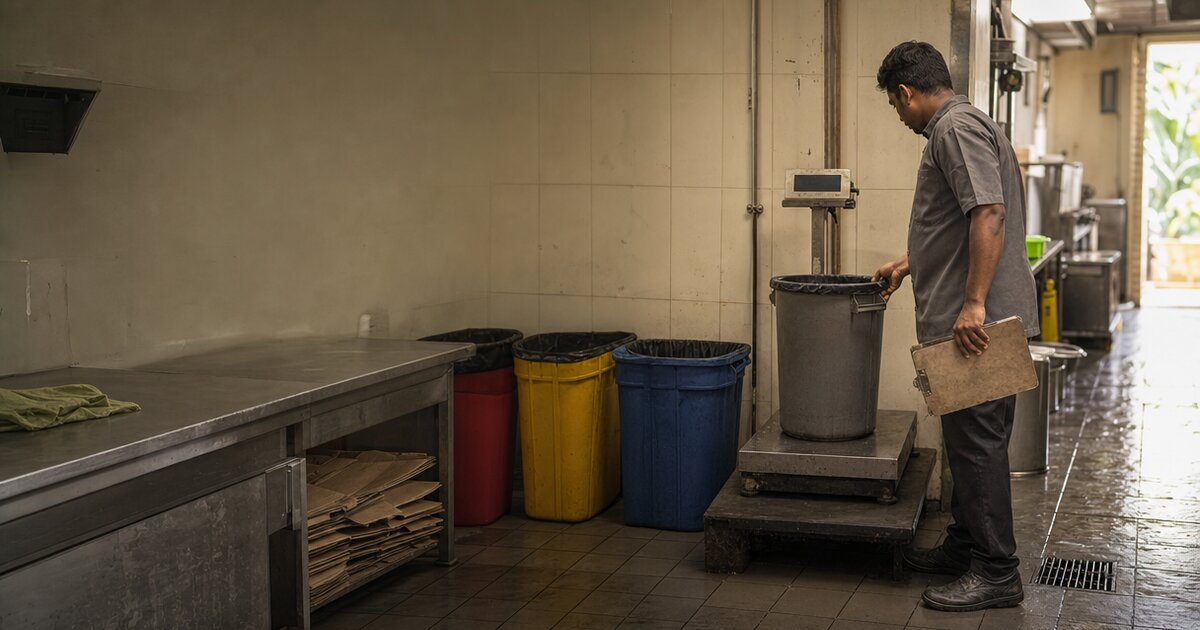
A closing-shift waste check needs three records on the same desk: the day’s weighing sheet, the water reading and the premises record. The number of bins is not the test. Neither is the number of covers.
The 2026 rules create two layers. One covers every waste generator, including small restaurants. The other adds registration, processing and reporting for a Bulk Waste Generator, or BWG. Mixing those layers makes a small outlet think it must register, while a large hotel may miss a threshold it actually crosses.
The answer turns on three tests
The Solid Waste Management Rules, 2026 took effect on 1 April 2026. The Gazette defines a BWG as a listed institutional, commercial or residential entity that satisfies at least one of these criteria:
| Test | BWG threshold | What to check |
|---|---|---|
| Building floor area | 20,000 sq. m. or above | Approved or sanctioned floor-area record |
| Water consumption | 40,000 litres per day | Meter readings or the utility record |
| Solid waste generation | 100 kg per day | Weighed total across the solid-waste streams |
The word or matters. A hotel does not need to cross all three. A compact property can qualify through water consumption or waste even when its floor area is far below 20,000 sq. m.
The Gazette lists hotels among commercial users. A restaurant also sits inside the wider commercial-establishment category, and Greater Chennai Corporation’s February 2026 BWG notice applies the same three tests to commercial establishments including hotels. If a restaurant occupies part of a mall, hotel or shared food court, do not guess whether the relevant measurement belongs to the outlet or the whole premises. Put that tenancy structure to the local body in writing.
Below the BWG threshold does not mean exempt
Rule 5 applies to every waste generator. It requires waste to be separated at source into four streams and handed over as the local authority directs:
| Stream | Typical restaurant examples |
|---|---|
| Wet waste | Kitchen scraps, food waste, vegetable and fruit waste, meat waste |
| Dry waste | Paper, cardboard, clean plastic, metal, glass and wood |
| Sanitary waste | Used sanitary products, securely wrapped and kept separate |
| Special care waste | Bulbs, paint containers, medicines and similar specified items |
That is the universal layer. The rules then name hotels and restaurants separately: within one year of the Gazette notification, they must work with the local body to maintain segregation, facilitate separate collection, hand recyclables to authorised waste pickers or recyclers, and process biodegradable waste on the premises through composting or biomethanation as far as possible. Residual waste goes to the collector or agency directed by the local body.
“As far as possible” is not permission to place mixed waste outside the gate. If space, odour control, drainage or staffing makes on-site processing impractical, record the constraint and get the local body’s route in writing. Use labelled holding points, separate movement from prep to disposal, and a known authorised receiver.
What changes when the restaurant is a BWG?
Crossing any one threshold adds Rule 6 duties. For a Chennai operator, the first practical difference is registration. The Gazette says a BWG must register with the concerned local body through the centralised online portal. GCC’s 18 February notice made registration compulsory for eligible BWGs in its jurisdiction and gave them 30 days from that notice.
That February window has passed. It is not a new grace period for a business discovering its status now. The CPCB solid-waste portal now exposes the central registration flow, but a Chennai establishment should also confirm the GCC process and its zone-level requirements rather than assume one web form completes every local step.
Registration does not complete Rule 6. A BWG must also:
-
arrange authorised collection and handover for dry, sanitary and special care waste;
-
collect and process wet and horticultural waste through composting, biomethanation or another approved technology;
-
operate adequate wet-waste processing if it is a new BWG;
-
if it is an existing BWG that cannot process wet waste on site, obtain the local-body exemption and procure Extended Bulk Waste Generator Responsibility certificates for the unprocessed quantity;
-
avoid handlers or facilities that lack the registration required by the rules; and
-
submit its annual return on the centralised portal by 30 June each year.
Extended Bulk Waste Generator Responsibility, or EBWGR, is easy to misread as permission to outsource the problem informally. It is a documented local-body mechanism. The Gazette ties certificates to waste collected, transported and sent to registered processors or recyclers. A cash payment to an unregistered collector does not create the evidence trail the rule describes.
The BWG test is three measurements joined by “or”, not one big-kitchen label.
Build the evidence file before buying equipment
Start with measurement. A composter selected before the kitchen knows its wet waste by day and by service can be too small for banquet peaks or needlessly large for normal trade.
Use a basic daily sheet with one row per stream:
| Date and service | Wet kg | Dry kg | Sanitary kg | Special care kg | Total kg | Handover or processing record |
|---|---|---|---|---|---|---|
| Lunch / dinner / event | Weighed | Weighed | Weighed | Weighed | Sum of four streams | Receipt, log or on-site batch |
Keep the weighing method consistent. Tare the bin or subtract its empty weight. Record preparation waste separately from plate returns if the kitchen wants to reduce cost, but add both when calculating the day’s solid-waste total.
Separating prep trim from plate returns answers two different questions. Prep trim points to yield and training; plate returns point to portion, menu fit or service quality.
Once the weight is credible, the guide to food-cost percentage explains how stock, purchases and sales meet; the food-cost calculator can then test the wider weekly number in the browser. Neither link replaces the waste register. They answer what the discarded kilograms cost.
A Monday routine for the person who owns this
Settle the status, then the process
Put facilities, kitchen operations and finance around one record. If each team keeps a different waste number, no one can apply the threshold or complete a return with confidence.
Pull the approved floor-area document, capture daily water use, and weigh all four solid-waste streams. Keep the source document beside each result.
Mark each threshold yes or no. One yes means the BWG workflow starts. For a shared building or a reading close to the line, request a written local-body interpretation.
Confirm the current GCC or local-body registration route. Check that every collector and processor used by the premises has the registration or authorisation the rules require.
Size on-site composting or biomethanation against measured wet waste. An existing BWG that cannot process on site should document the constraint before seeking the exemption and EBWGR certificate route.
Keep monthly weight, handover and processing records reviewable. The annual return should be a summary of an existing trail, not a reconstruction made the week it is due.
A July 2026 report on GCC inspections described checks for registration, segregation, on-site wet-waste processing and sanitation. FHRAI also circulated the new rules to hotel and restaurant leaders in February.
Those are useful signals of implementation. The Gazette and the local body’s current directions remain the documents to use for the actual decision.