
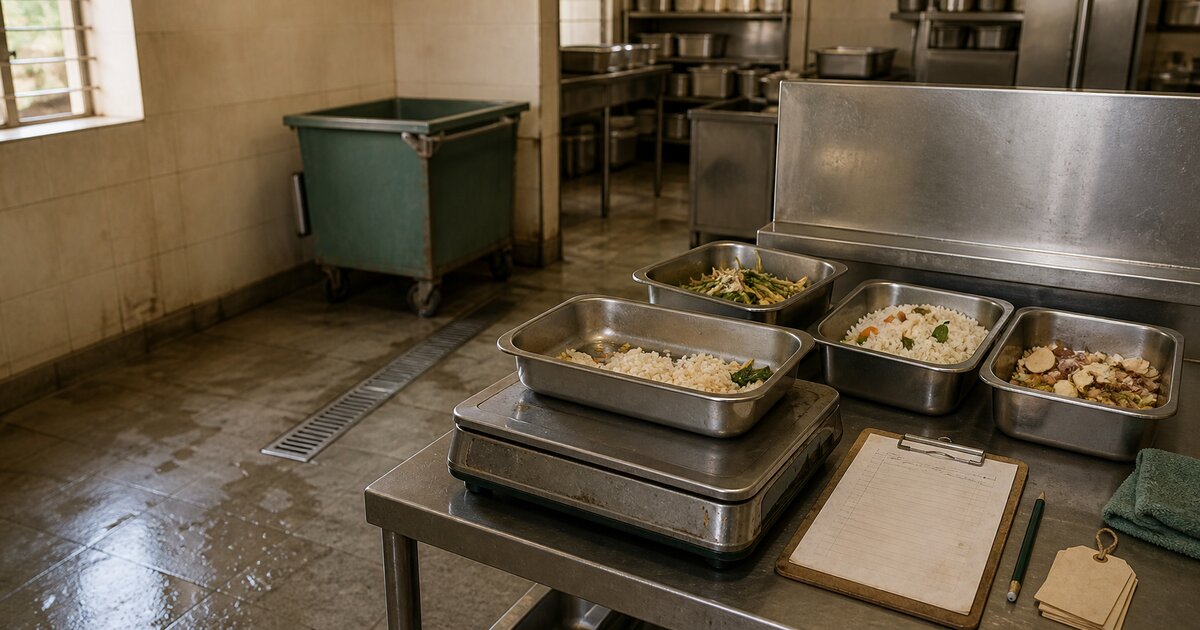
At the end of breakfast, a hotel can know the weight of its wet-waste bin and still know almost nothing about the meal. Did the waste come from spoiled stock, vegetable prep, a late buffet refill, guest plates or staff dining?
The scale did its job. The log did not.
A food-waste record becomes useful only when it connects the discarded food to the decision that produced it. Start at source, keep the categories few enough for a busy shift, and check that each expected station actually reported.
The garbage-room total comes too late
A 2026 qualitative study interviewed nine culinary, food-service and general managers across eight chain or three-star-and-higher hotels in India. Most said the stewarding team weighed waste at the central garbage room. Few measured it before composting, and only one hotel monitored waste daily at the production and service source. The managers wanted day-wise, source-wise, meal-wise, customer-wise and item-wise information, but described manual logging as time-consuming and inconsistent (Raju and colleagues, 2026).
That study is a small purposive sample. It does not tell us the average waste rate for an Indian hotel. It does expose the measurement gap: one mixed number can support collection or disposal records, but it cannot tell a chef whether to change a purchase quantity, trim standard, batch, refill or portion.
Keep statutory waste records separate from this operating log. India’s Solid Waste Management Rules have their own duties and thresholds; our explainer on Bulk Waste Generator rules covers that layer. The kitchen log below is for finding preventable food loss.
Give every discarded item one waste point
Use categories that map to different decisions. Five is enough for a first baseline.
| Waste point | What belongs here | Decision it can change |
|---|---|---|
| Storage and spoilage | Expired, damaged or temperature-abused stock | Order quantity, receiving, rotation or storage |
| Preparation | Trimmings, yield loss and production errors | Buying grade, trim standard, recipe or training |
| Unserved surplus | Prepared food that never entered guest service | Forecast, batch size or production release |
| Service return | Food returned from a buffet, banquet or service counter | Display quantity, pan size or refill timing |
| Plate waste | Food served to a guest and left uneaten | Portion, quality, menu fit or service explanation |
Track inedible parts separately when the operation can do it consistently. A hotel measurement methodology developed by WWF and Greenview includes both solid food waste and inedible parts in the food-waste boundary, while noting that many hotels do not separate them. It also treats food waste per customer or per meal as useful additional measures when the hotel collects the matching customer data (Hotel Waste Measurement Methodology).
Keep one row small enough for service
The team should be able to complete a row beside the bin, not reconstruct it from memory after service.
| Field | Minimum entry | Why it matters |
|---|---|---|
| Date and service | 5 Sep, breakfast | Makes like-for-like comparison possible |
| Outlet or event | All-day dining, banquet A | Stops one busy outlet hiding inside the hotel total |
| Waste point | Preparation, surplus, return or plate | Connects weight to the operating decision |
| Item or group | Idli, cut fruit, mixed plate waste | Gives enough detail to act without slowing every discard |
| Net weight | Kilograms after container tare | Keeps the measure comparable |
| Reason | Forecast miss, spoilage, trim, refill, portion | Records the team’s best current explanation |
| Customers served | Covers for that service or event | Allows kilograms per customer |
| Owner | Station or role, not a private name | Shows who closes a missing row |
Choose item-level detail for expensive or repeated hotspots. A mixed plate-waste category may be enough on day one; a repeated rice or pastry pattern earns its own line later. The current hotel audit guidance from d2o uses the same practical logic: separate the source, outlet, service period, food type and likely cause, then analyse waste per cover or event (hotel food-waste audit guide, March 2026).
Calculate two different rates
Food waste per customer = measured food-waste kg ÷ customers served
Log completeness = completed expected entries ÷ expected entries × 100
The first rate lets a property compare similar breakfasts or banquets of different sizes. It is not automatically comparable across unlike outlets, menus or hotel formats. The second asks whether the denominator is honest.
Suppose the morning plan requires one entry from preparation, buffet return and plate waste for each of two breakfast outlets. That creates six expected entries. If four are complete, the log is 67% complete, whatever the recorded kilograms say. This is illustrative arithmetic, not a hotel-industry target.
Measure the waste, then measure whether the measuring happened.
A clean spreadsheet can still be wrong
A 2026 controlled study compared staff-reported tracking with researcher-run measurement in three healthcare kitchens and one hotel kitchen. At the hotel breakfast buffet, staff reporting understated the measured food flows by about 30.7% overall. Underreporting varied by category: buffet setup and refill was closest, while buffet returns and other food waste were missed more heavily (Leverenz, Flores and Eriksson, 2026).
One hotel breakfast cannot supply an Indian benchmark, and the study did not test every type of service. Its warning is still operationally important. Missing days, skipped categories and low weighing frequency can make a stable looking chart systematically low.
Audit the process once a week:
- Are there entries from every planned station and service?
- Were full containers tared, weighed and logged before mixing?
- Does the number of weighing events look plausible for the shift?
- Did a supervisor observe one service independently and compare totals?
- Are busy periods producing more blanks than quiet periods?
Do not use the log to punish the person who reports a high number. That teaches the next shift to report a smaller one.
Add cost only after the physical flow is clear
Kilograms and rupees answer different questions. Start with weight because it is observable. Then cost the hotspots with a method the finance and kitchen teams can reproduce.
- For spoiled raw stock, use the dated landed invoice rate and the discarded quantity.
- For preparation loss, compare actual usable yield with the recipe or buying specification before assigning a cost.
- For unserved prepared food or service returns, use the batch’s ingredient cost and measured fraction discarded. Do not call menu selling price “waste cost”.
- Use plate-waste weight first for portion and quality decisions. Exact recipe cost may be impractical when a mixed plate contains several items.
The monthly food-cost calculation remains a separate stock-and-sales control. Our food-cost percentage guide explains how opening stock, purchases, closing stock and sales fit together. The waste log explains one cause of movement inside those totals.
Run a seven-service baseline
Seven comparable services are a manageable diagnostic start, not a published benchmark. Extend the run when the pattern changes by weekday, occupancy, event type or season.
A baseline the team can finish
Walk one service from stores and preparation through buffet, banquet, plate clearing and the garbage room. Mark every point where food can be mixed before weighing.
Use storage, preparation, unserved surplus, service return and plate waste. Add an item line only when it will change a decision.
Give each measurement point a labelled container and a visible tare. Keep packaging and non-food refuse out of the food-weight entry.
Write the stations and services that must report. A blank becomes visible rather than quietly becoming zero.
Compare kilograms per customer, completeness and cause across like-for-like services. Change one controllable input, then measure again.
If late buffet returns dominate, the next question is release size rather than total production alone. The hotel buffet refill guide shows how remaining customers, recent pace, food already displayed and safe reserve can shape that decision.
FSSAI’s Save Food, Share Food initiative encourages food businesses to prevent waste and connect suitable surplus to safe recovery. A log does not establish that discarded food is safe to donate or reuse. Those decisions still need a known time-and-temperature history and the applicable food-safety process (FSSAI Eat Right India handbook).