
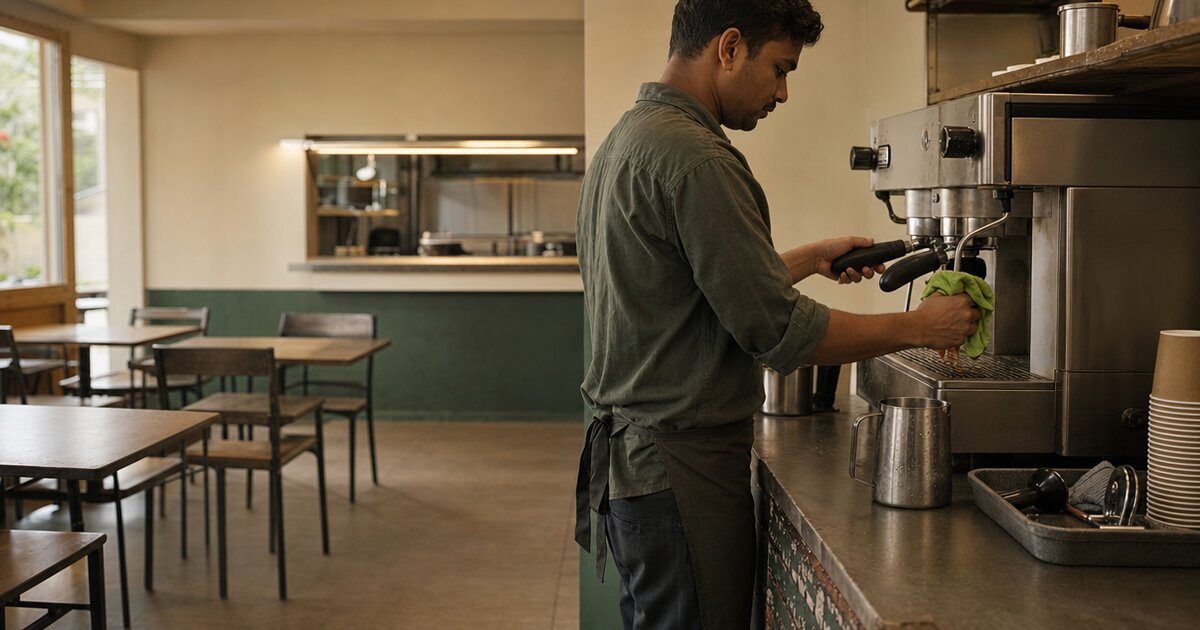
At 3:30 pm, a burger counter in Chennai may have paid staff, lights, cooling and rent but only a thin order rail. A coffee station gives that site another reason to be visited before the dinner rush. That is the strategic attraction: more occasions from an existing restaurant.
Coffee does not make the fixed cost disappear. It adds equipment, cleaning, milk handling, training and another queue. The menu earns its place only when the quieter hour produces repeat transactions and a defensible contribution.
What the current India evidence shows
India’s coffee market is growing, but the strongest public evidence does not say every restaurant should become a cafe.
The Coffee Board of India’s April 2024 consumption study estimates domestic coffee consumption at 91,000 tonnes of green-bean equivalent in 2023, up from 84,000 tonnes in 2012. The study used a sample of 2,500 urban and rural consumers and says higher at-home use and out-of-home consumption in cafes both contributed to the increase (Coffee Board of India and CRISIL). National tonnage establishes a broader demand base. It does not provide a Chennai outlet’s footfall, selling price or beverage margin.
Company disclosures show how one QSR operator is using that opportunity. At March 2026, Westlife Foodworld reported 478 McDonald’s restaurants across 78 cities and 100% McCafe penetration across its eligible store base. Its Q4 FY26 presentation also records a monthly coffee subscription designed to build habit and frequency, and describes the restaurant model as multi-daypart (Westlife Foodworld, 7 May 2026).
| Signal | What it supports | What it does not prove |
|---|---|---|
| Coffee consumption: 84,000 tonnes in 2012 to an estimated 91,000 tonnes in 2023 | India’s domestic coffee base expanded over the study interval | Visit frequency or profit at one restaurant |
| 2,500-person Coffee Board study | The estimate has a disclosed consumer-survey basis | A census of every Indian coffee drinker |
| McCafe at 100% of Westlife’s eligible restaurants | Coffee is a network platform, not a handful of pilots, for this operator | That the same format fits every QSR |
| A monthly coffee subscription | The operator is testing habit and visit frequency, not only one-off attachment | The result of that programme |
The current rollout picture is wider than one company. An August 2026 report records Cafe Domino’s opening a cafe-format outlet, Burger King management saying BK Cafe is present in most or all of its restaurants, and Devyani International discussing an India experiment with KFC’s beverage sub-brand Kwench. Devyani described it as a test that would need to succeed before a national rollout (Moneycontrol, 5 August 2026).
That distinction matters. An installed platform, a first cafe-format outlet and a proposed experiment are three different stages.
The target is another occasion
A food-led QSR usually has a clear lunch and dinner proposition. Coffee can stretch the site into breakfast, mid-morning, mid-afternoon or a short meeting. It can also attach to an existing food order. Those are separate jobs and they need separate measures.
| Coffee job | First number to watch | Operational question |
|---|---|---|
| Bring in a quiet-hour visit | Beverage-only paid transactions by half-hour | Did the drink create a visit or shift one from another time? |
| Add to a food order | Beverage attachment rate | Did the drink lift the basket without adding a queue? |
| Build a repeat habit | Returning beverage transactions | Did trial become ordinary behaviour? |
| Use existing floor area | Contribution per labour hour | Did the site earn more after the extra work? |
The room may already be open, but the service capacity is not free. A machine needs counter space. Milk needs cold holding. Cups and lids need storage.
Someone has to dose, texture, assemble, hand over and clean while the fryer and dispatch line continue moving.
Measure incremental contribution, not beverage hype
Coffee is often described as a high-margin category. That label is not a unit economics sheet. Westlife’s FY26 disclosure says input inflation affected coffee and cocoa, while its published gross margin covers the company rather than McCafe drinks alone.
For one test window, calculate:
Incremental contribution = net beverage sales − ingredients − cup and lid − channel fees − extra labour − measured waste
Use net sales after discounts and refunds. Cost milk, coffee, sweetener, flavouring and ice at the actual recipe dose. Record discarded milk, remade drinks and closing waste instead of burying them in the monthly purchase line.
The related guide to tea cost per cup shows the same batch principle: cost what went into the batch, divide by what was actually sold, and keep contribution separate from net profit. An espresso station has different equipment and recipes, but waste still changes the cost carried by each sold cup.
Coffee earns a QSR daypart when it creates repeat contribution, not when the menu photograph looks like a cafe.
Do not allocate the whole restaurant’s rent to a two-hour trial and call the test unviable. The first decision is narrower: did the new window cover its incremental cost and use spare capacity productively? Equipment depreciation, maintenance and the eventual share of occupancy still belong in the rollout decision.
The food line can pay for a bad coffee experiment
The fastest way to overstate the opportunity is to count beverage sales while ignoring what happened beside them.
Queue interference
If the same cashier, pickup shelf or delivery rider handoff serves food and coffee, one slow custom drink can delay several core orders. Track ticket time during the test window and through the first dinner overlap.
Recipe drift
A short menu is easier to train and count. Large, syrup-heavy menus multiply bottles, expiry dates, pump settings and remake reasons. Two staff members should build the same drink to the same weight and fill.
Milk and ice handling
The visible coffee dose is only one perishable input. Milk opened for a weak daypart, prepped cold beverages and ice handling can create waste or a food- safety problem. The sales sheet needs a discard row, not a hopeful theoretical yield.
Cleaning and downtime
Machines need purging, wiping and scheduled cleaning. The work often lands after the sales window, which makes the drink look faster on the till report than it was on the shift.
Run one daypart for four weeks
A bounded coffee test
Choose one window and one customer job: a breakfast add-on, an afternoon beverage-only visit, or a drink attached to a food order. Do not mix all three in the first result.
Start with drinks that share a base and use repeatable measured builds. Write the recipe, cup size, sell price and discard rule before launch.
Separate beverage-only orders, food-plus-beverage orders, discounts, remakes and discarded inputs. Record service time in the same half-hour blocks.
Subtract the full variable cost and extra labour from net beverage sales. Compare the result with queue time, waste and the core food line.
Expand only when the target window produces repeat transactions and a stable build. Otherwise shorten the menu, change the occasion or stop.
At month-end, place the beverage trial inside the wider food-cost percentage review. That article shows why opening stock plus purchases minus closing stock is more reliable than reading purchases alone. The coffee station still needs its own waste and labour view; a whole-restaurant percentage cannot diagnose a slow drink line.