
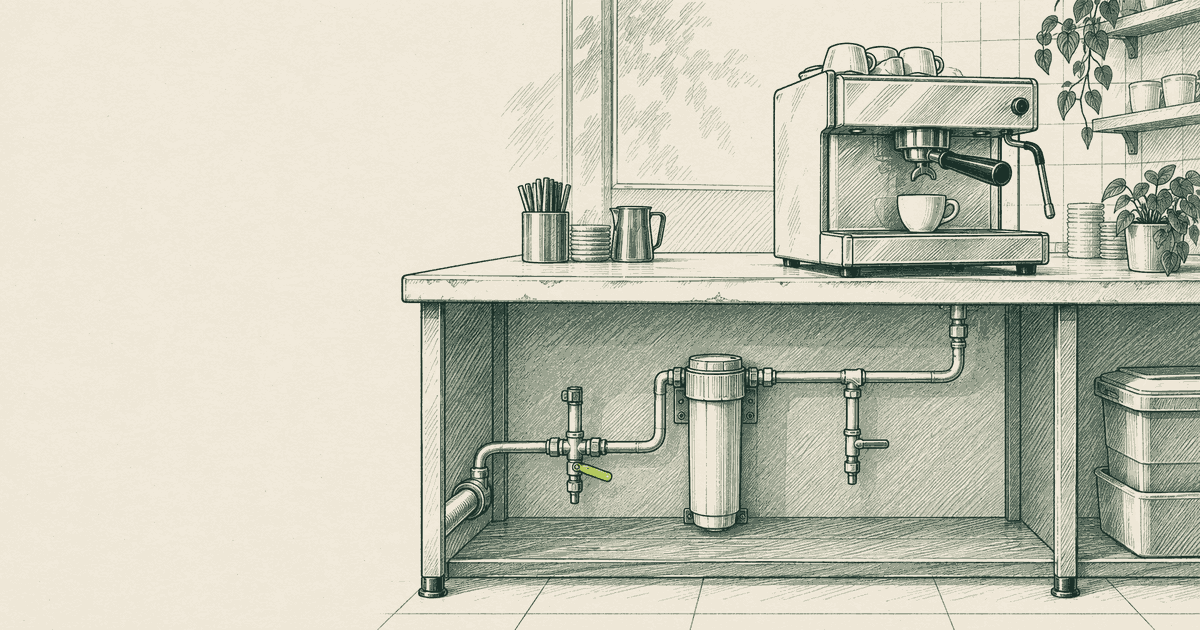
A small water tester fits beside the grinder. The result is quick to read and easy to put on an opening sheet. For a Chennai cafe buying an espresso machine, that makes it tempting to ask the installer for one acceptable TDS number and consider the water settled.
Keep the meter. Change what its reading is allowed to decide.
Water arriving at the premises, water leaving the treatment system and water entering the coffee machine are different sampling points. A result without its sampling point leaves the next shift guessing. Even a correctly recorded TDS value cannot tell the manager which dissolved substances produced it.
What the meter actually measures
TDS means total dissolved solids. In a conductivity-based tester, the displayed value is calculated from electrical conductivity using a conversion factor. Hanna’s instrument manual documents that conversion explicitly, along with temperature-compensation settings. Read your own meter’s instructions before comparing its result with somebody else’s.
The practical limit is simple: this is an aggregate reading, not a mineral analysis. Similar displayed values do not establish similar hardness or alkalinity. A water TDS pen also does not measure the strength of brewed coffee in the way a coffee refractometer is used to assess a beverage.
| Record | What it helps answer | What it cannot settle alone |
|---|---|---|
| Water TDS / conductivity | Has this monitored supply changed? | Which minerals or contaminants are present |
| Total hardness | What is the calcium and magnesium contribution? | Full scale or corrosion behaviour in a particular machine |
| Alkalinity | How strongly will the water resist acidification? | Whether the water is safe to drink |
| Potability report | Does the tested sample meet the relevant drinking-water assessment? | Whether it suits the espresso machine or tastes best with this coffee |
| Model-specific water specification | What water does the equipment require? | Which finished drink customers will prefer |
The chemistry terms have separate jobs. In Marco Wellinger’s SCA explanation of water and coffee acidity, alkalinity describes resistance to a change in acidity. It is different from pH, which describes the current state. The amount of water meeting a given amount of coffee also changes that interaction.
That is why a filter-coffee taste preference should not become an espresso-boiler setting by simple copy-and-paste. The article discusses sensory possibilities alongside equipment limits; it does not establish a universal water recipe for every brewing method.
Which limits belong to your machine?
Use the installed model’s current documentation and the service provider’s interpretation of the actual water report. Keep the document version with the commissioning record.
For a concrete example, La Marzocco’s published water specification lists TDS of 90–150 ppm, total hardness of 70–100 ppm and alkalinity of 40–80 ppm. Its table also covers pH, iron, chlorine and chloride. These are that manufacturer’s published parameters, not an Indian drinking-water standard or a universal cafe target.
Hardness and alkalinity results must retain their reporting basis, commonly expressed as calcium-carbonate equivalent. Do not compare a value in degrees of hardness with a ppm limit without the correct conversion.
If the service provider accepts the supply, ask which sample and which specification support that decision. If they recommend treatment, the proposal should identify what needs to change and how the outlet result will be verified. “Suitable for coffee” is too broad to record as the commissioning result.
This work belongs in the opening budget alongside equipment and training. The wider question—whether coffee can earn its place in a restaurant’s daypart—is covered in our analysis of QSR coffee formats. A water specification supports that service; it cannot establish demand for it.
Why RO does not finish the decision
“RO water” names a treatment process. It does not provide a complete description of the water delivered to the machine after storage, blending or mineral adjustment.
There are commercial systems that combine reverse osmosis with a subsequent mineral stage. BWT’s original system description documents that arrangement. It demonstrates a possible architecture, not a reason every Chennai cafe needs that product or any RO installation.
Ask for a treatment proposal against your inlet report, expected demand and machine requirements. The useful deliverable is an agreed outlet specification with a way to check it. A promise to make the meter display a lower number leaves too much unspecified.
A water reading needs a sampling point and a decision it is allowed to support.
Give the technician the actual operating constraint. Confirm space for service access and replacement-cartridge storage. Name who can isolate the system and the approved supply while it is unavailable. These are procurement questions the cafe can answer before installation.
Do not infer a replacement interval from a neighbouring cafe’s calendar. Retain the supplier’s service basis for this installation, the date work occurred and the meter or volume records used. A cartridge-change sticker is useful, but it does not describe the treated water by itself.
A water record the next shift can use
The following is a proposed operating routine, not a measured Mikro customer case or a statutory testing schedule. It keeps the evidence available to the manager, roaster and service technician without asking every barista to become a water chemist.
Build the record around the supply
Sketch the route from the incoming source through storage and treatment to the machine. Give the cold inlet and treated outlet distinct names. Follow the test method and technician’s sampling instructions; do not improvise a sample from a hot boiler.
File the potability report, water chemistry results, units, sample dates and equipment specification. Record unknown parameters as unknown. A photograph of the TDS display can accompany the record, but cannot stand in for the missing report.
Set the routine with the responsible food-safety and service teams. Add a review after a source change, treatment adjustment or relevant service work. Record who checked the result and whether the supply was accepted, investigated or withheld.
Once both waters are potable and suitable for the equipment being used, keep the coffee lot, recipe and preparation method fixed. Code the cups, note preferences and repeat the comparison. If grind, dose and water all change together, the result cannot isolate water’s contribution.
Keep the tasting notes modest. “Preferred in this comparison” is a useful result. “Best water for Chennai coffee” would require evidence far beyond one counter’s test. Record inconclusive comparisons too; they do not justify a treatment change merely because the cafe has already spent time testing.
The cost record should be equally specific. Add the actual treatment consumables, relevant service charges, testing and attributable water cost for the review period. Divide that allocated cost by drinks actually sold, stating which costs serve other kitchen uses. This is proposed outlet arithmetic, not a published industry cost benchmark.
Our tea cost-per-cup guide explains why sold yield is the useful denominator. Once you have a per-serving allowance, the food-cost calculator can help carry it into a drink calculation. It cannot estimate filter life or certify a water supply.