
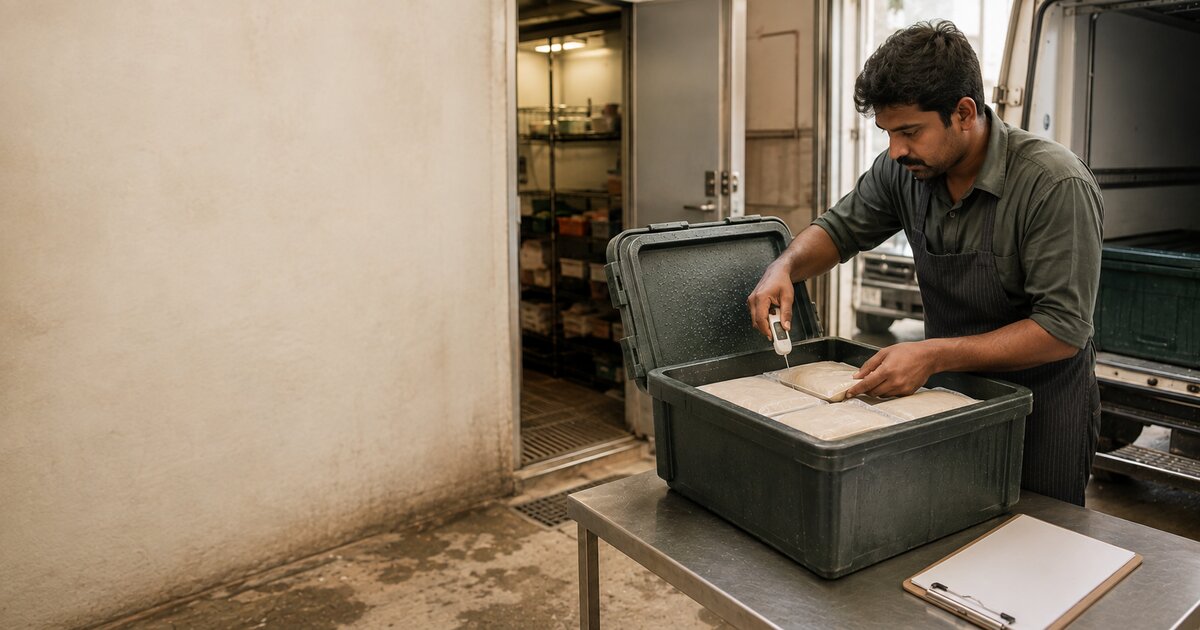
A refrigerated van reaches a Chennai restaurant at 11:20, just before lunch. The driver wants a signature. The freezer has space. One carton feels cold, but the receiving thermometer and the purchase order are still inside the office.
That is the point where a cold-chain promise becomes the restaurant’s stock. A quick touch cannot settle it. Neither can the temperature glowing on the vehicle dashboard.
Start with the right temperature limit
FSSAI’s Schedule 4 direction says the receiving temperature of high-risk food must be 5°C or below, while frozen food must be −18°C or below. The same section says high-risk and frozen food should be transferred quickly into storage maintained at those temperatures (FSSAI Schedule 4 direction).
Those numbers are a starting boundary, not a universal specification for every product. FSSAI’s catering-sector guidance uses a tighter receiving control of 4°C or below for chilled food and says frozen food should be entirely frozen. It tells the receiver to use a thermometer, check appearance and reject non-conforming material while informing the supplier (FSSAI catering-sector guidance).
The guidance is implementation guidance, not a replacement for the applicable regulation. Your accepted limit should therefore come from the product, the law that applies to it, and the restaurant’s documented purchase specification. If the supplier agreed to deliver a chilled item at 4°C or below, a 4.8°C reading does not pass merely because the wider high-risk limit is 5°C.
One reading is not the whole receiving check
Temperature is essential, but a cold damaged pack can still be unacceptable. A sound carton can also contain the wrong product. FSSAI’s material-receiving requirements pair temperature control with documented specifications, supplier control, incoming inspection, label review and procurement records.
Use one short sequence for every temperature-controlled delivery.
| Check | What the receiver verifies | Evidence to keep |
|---|---|---|
| Product | Name, pack size and chilled or frozen state match the purchase order | Purchase order and invoice |
| Temperature | The food meets its documented limit, measured by the approved method | Reading, time, item or lot and device ID |
| Pack and condition | Seal is intact; no leakage, swelling, heavy frost, thawing or visible deterioration | Exception note or photo under the outlet’s policy |
| Label and traceability | Manufacturer, batch or lot, dates, storage instructions and allergen information are usable | Label or lot record |
| Vehicle and separation | Load area is clean; food is protected from chemicals, waste and cross-contamination | Vehicle or delivery check |
| Transfer | Accepted stock reaches the correct chiller or freezer within the site’s defined time | Receiving and put-away time |
The table is deliberately wider than “check the temperature”. FSSAI’s catering guidance treats the vehicle’s hygienic condition and the raw material’s temperature as separate checks. A clean refrigerated van supports the decision; it does not prove that the carton in front of you meets the agreed limit.
The reverse is also true. A compliant temperature does not prove product identity. If the invoice, pack and kitchen description disagree, settle that before the carton enters stock. The explainer on checking paneer identity at receiving shows why documents and traceability can matter as much as appearance.
Measure in a repeatable way
A thermometer is useful only when the team knows which item to check, where to check it and what result triggers action. A receiver who measures a random carton today, the van air tomorrow and the chiller after put-away on Friday has three numbers that cannot be compared.
The exact method depends on the product and the outlet’s food-safety plan. It may use a non-destructive between-pack check, a probe on a designated sample, or another validated method. Do not pierce a sealed ready-to-eat pack merely to improvise a reading. Record the method beside the limit and train the receiver to use it the same way.
The device needs control too. FSSAI’s revised 2025 catering inspection checklist asks whether measuring and monitoring devices are calibrated periodically. It also checks that incoming material is stored according to its temperature requirement and that food-transport vehicles maintain the required temperature (FSSAI revised inspection checklists, 3 April 2025).
Decide before the kitchen is under pressure
The weakest receiving system has only two states: sign now or argue with the driver. A better procedure has three.
| Decision | When used | Next move |
|---|---|---|
| Accept | All checks pass | Record and put away |
| Hold apart | Result is unclear; safe control can continue | Mark the lot, prevent use and escalate |
| Reject | Outside specification, damaged or wrongly identified | Record, inform the supplier and keep out of stock |
“Hold apart” is not permission to leave the carton beside the back door. It is a controlled, time-bounded status inside the outlet’s procedure. If safe control cannot be maintained while the question is resolved, the hold option has failed.
Do not quietly refreeze a soft frozen product and remove the evidence. The receiving record should show the item or lot, measured result, condition, decision, receiver, supplier response and replacement or credit reference. That record helps the buyer distinguish a one-off damaged carton from a route, vehicle or supplier pattern.
The signature is not the end of delivery. It is the moment the cold-chain evidence changes hands.
Build a ten-minute routine, not a ten-minute law
FSSAI’s catering guidance gives storage within ten minutes as an example in its receiving plan. It does not make ten minutes a universal safe allowance for every item and every Chennai loading bay. Use it as a design prompt: how long does your own route from van to store take when the lunch delivery, garbage movement and prep team all meet at the same door?
Set up the receiving routine
For each temperature-controlled line, record the product identity, chilled or frozen state, acceptance temperature, measuring method and rejection condition. Put the same terms on the purchase order.
Keep the clean thermometer, log and marker ready. Clear the route to the chiller or freezer before unloading begins.
Follow the outlet’s sampling and measurement method. Inspect the vehicle, packs, labels, dates and condition while the load remains controlled.
Mark the lot accepted, held apart or rejected. Give the receiver written authority to stop non-conforming stock from entering kitchen use.
Each month, group exceptions by product, delivery route and supplier. Review repeated temperature drift, packaging damage, replacements and late put-away rather than arguing from memory.
Receiving is only the first checkpoint. A compliant carton can still be mishandled during storage, preparation or service. For the later holding decision, the guide to smaller hotel buffet refills shows why safe reserve and displayed food need separate control.
Frequently asked questions
Frequently asked questions
5 QWhat temperature should chilled food be delivered at in India?
What temperature should frozen food arrive at?
Is the temperature on the refrigerated van enough?
Can a restaurant accept a warm delivery and chill it later?
What should a food receiving log contain?
For more evidence-led food-business operating guides, browse Mikro’s English articles.